
Does Quantum Physics Have No Logic? What The Experiments Actually Found
“After A comes B. After B comes C.” You learned it at four, and it may still shape how you think the world works. People say quantum physics broke that rule — that there is “no logic” left. A seeker should accept neither that sentence nor its opposite until the evidence has been seen.
Here is a small thing nobody ever asked you to question.
Why does the alphabet begin with A?
Not because the universe demands it. Because people decided, wrote it down, and taught it to every child. The order is a tool. It was never a law.
Look at our own scripts. The Devanagari consonants do not march in a random line — they climb through the mouth, from the back of the throat to the palate, to the teeth, to the lips. Tamil sorts its eighteen consonants into three families of six: hard, soft and medium. Different civilisations, different logics, one job: arranging sound.
So when someone says, “the world has no logic,” a seeker pauses. Whose logic? Which order? Compared with what?
This post follows that question as far as the evidence will carry it. Some of what you read will contradict what school taught you. Some will contradict what you have been told “science says.” And one of the most popular claims about quantum physics — you don’t need proof — will not survive the very experiments people quote in its favour.
A Sequence Is A Tool, Not A Prison
School handed you one of the most useful tools ever invented: the ordered step. This before that. A recipe needs it. A proof needs it. A wound heals in it. Skip a step and you can get hurt.
But a tool is not the whole workshop. A smell drops you into a childhood kitchen with no steps in between. You recognise a face before you can say the name. A musician hears where the phrase is heading and bends it mid-air. That is not “no thought.” It is thought taking other routes:
- Sequence asks: what came before, and what follows?
- Association asks: what is connected to this?
- Pattern asks: what familiar shape is hiding here?
- Inference asks: what do these clues support?
- Imagination asks: what else could be true?
A sequence keeps you on the road. An association shows you the road you did not know was there.

The popular claim: “School turned us into linear thinkers.”
What the evidence says: not quite. A 2026 meta-analysis (Donenfeld and colleagues, Journal of Experimental Child Psychology) pooled studies of children of similar ages who had different amounts of schooling. It found a small but consistent boost in executive functions — the skills that hold information in mind, resist impulse and switch attention. The pool of studies was modest, so read it as a signal, not a verdict.
The real risk is narrower, and more human: when a child is rewarded only for repeating the expected route, the questions that don’t fit the route go quiet.
Your Brain Was Never A Single Line
The brain is not a train on one track. Vision, memory, language and prediction run through many interacting networks at once. And yet two demanding tasks cannot always share your attention: responses slow, and mistakes creep in.
So which is it — serial or parallel? A 2015 review of the multitasking research (Fischer and Plessow) says the question itself is too simple. Both happen, and which one wins depends on the conditions. The schoolbook’s “one thing at a time” and the internet’s “multitask like a genius” are each half right.
Now an experiment that should unsettle you.
Volunteers watched a short film of people passing basketballs and were asked to count the passes. Halfway through, a person in a gorilla suit walked into the middle of the scene, thumped their chest, and walked out. About half of the viewers never saw it (Simons and Chabris, 1999).
The gorilla was not hidden. Attention was simply spent elsewhere.

Read that again as a seeker. The viewers’ thoughts did not change the gorilla. They changed how much of the gorilla they could see. That is a measured, repeatable way in which thinking shapes the world you experience — and it needs no mysticism at all.
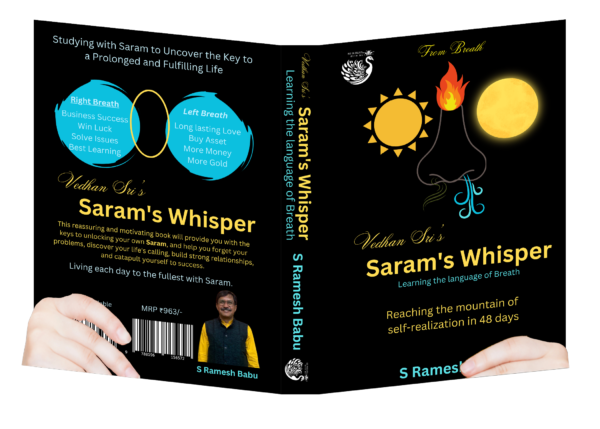
Vedhan Sri’s Saram’s Whisper — Learning The Language Of Breath
If watching your own attention fascinated you, here is a 48-day journey that begins with the breath: four symbolic mountains, with stories, practices and quiet reflections, rooted in Siddha wisdom. Our answer to Ikigai — a reason to rise each morning — and a book made to be given.
₹963
See the bookWhat Do People Mean By “There Is No Logic”?
Ask five people and you may get five different meanings. Most of the confusion lives in that gap.
| What is said | What it may really mean | How a seeker tests it |
|---|---|---|
| “I can’t see the reason.” | A reason may exist; you have not found it yet. | Look for what is missing. |
| “This breaks my expectation.” | Surprise is not the absence of rules. | Ask which expectation was wrong. |
| “The facts allow more than one answer.” | The evidence does not yet pick one explanation. | Ask what would tell them apart. |
| “The steps contradict each other.” | The argument is inconsistent. | Find the exact clash. |
| “Only probabilities are predicted.” | A theory gives odds, not certainties. | Check the odds over many trials. |
Confusion is not proof of mystery. Surprise is not proof of impossibility. Randomness is not proof that anything goes.
Quantum Physics Logic: What Really Broke, And What Didn’t
Now the big claim. Does quantum physics have no logic? Let us separate what was truly broken from what was only rumoured to break. Quantum physics logic is not the logic you learned at school — but it is not the absence of logic either.
The thing that truly broke: local realism
For centuries two ideas felt too obvious to question. First, that things have definite properties whether or not anyone measures them — realism. Second, that no influence travels faster than light — locality. Together they are called local realism.
In 1964 John Bell turned this into a testable limit. If the world is built only on those two ideas, then results measured far apart can agree only so well. Picture each particle of a pair carrying a pre-agreed set of instructions, like two sealed envelopes. Quantum theory predicts that the results will agree better than any envelopes allow.
Experiments say quantum theory is right. In 2015, three independent teams ran “loophole-free” versions of the test, one with electron spins separated by 1.3 kilometres. In 2022 the Nobel Prize in Physics went to Alain Aspect, John Clauser and Anton Zeilinger “for experiments with entangled photons, establishing the violation of Bell inequalities.”
So something in our everyday picture has to go. Which part — realism, locality, or something subtler like “only one outcome happens” — is exactly what physicists still debate. What is not debated is the result itself. And note what it does not allow: no message can be sent faster than light this way.
A hundred thousand people, one question
One stubborn objection was left. The experiment’s own “random” settings might, somehow, be secretly linked to the particles. Bell himself suggested a remedy: let free human choices pick the settings.
On 30 November 2016, about 100,000 people around the world played an online game whose only task was to tap out unpredictable 0s and 1s, as fast as they could. Their choices were streamed live to laboratories on five continents, where they decided how entangled particles would be measured.
The verdict, published in Nature in 2018: the correlations strongly contradict local realism, even when human choices set the measurements.

Notice what the experiment did and did not show. Human choices selected the settings. They did not bend the outcomes. The universe was asked 97 million questions, and the strange correlations held.
1936: even logic got rewritten
Long before any of this, the mathematicians Garrett Birkhoff and John von Neumann asked a daring question: if quantum statements behave differently, perhaps the logic of those statements does too. They showed that a familiar rule of “and” and “or” — the distributive law — fails for quantities that cannot be measured together.
Logic did not vanish. It grew a new branch with precise rules of its own. (Whether that branch deserves the name “logic” is still argued by philosophers. A seeker enjoys that argument.)
The part physicists still argue about: who is the observer?
Here the popular story runs ahead of the science. You have heard it: “observation changes reality, so the mind creates reality.”
In physics, a measurement means a physical interaction that records a result. Whether a conscious mind is needed is a real, open debate. One old idea — associated with von Neumann and Wigner — says consciousness might play a role. Most physicists reject it. A 2011 paper argued that experiments rule it out; a later reply argued that its reasoning has a flaw. The question stays open.
Recent experiments push it in a stranger direction. In 2020, physicists built a modern version of the “Wigner’s friend” puzzle with photons and proved that at least one of three assumptions must fail: locality, no-superdeterminism, or the idea that every observed event is an absolute fact for everyone (Bong and colleagues, Nature Physics). The “observer” in that experiment was a single photon’s path — not a person. So it shakes what we mean by a “fact,” but it says nothing about thoughts creating events.
“We don’t know” is an honest sentence. It is not the same as “anything goes.”
Even recent surprises get contradicted
In 2025 a team reported a Bell violation without entanglement — a result that, if it held, would overturn a textbook assumption. Within months, other physicists published analyses arguing that the apparent violation comes from how the test was set up, and that the same data can be reproduced by a local model.
That is not science failing. That is science doing its job: a claim, a challenge, a repeat. A seeker should love this.
“You Don’t Need Proof”: The One Sentence A Seeker Should Refuse
You may have heard the strongest version of the story: after quantum physics there is no logic left, what you think is what you get, and you don’t need proof.
Here is the contradiction, offered with respect. That sentence fails by a seeker’s own standard — the standard that says don’t believe it just because you were told; look for yourself.
- The experiments themselves demanded proof. The work above is some of the most proof-hungry in the history of science: 97 million human choices to close a single loophole.
- No experiment accepted by the physics community shows a thought, by itself, producing an outside event. The strangeness of quantum results is about correlations and facts — not about wishes.
- And yet thought does shape your world, in three ways you can test. It filters what you notice (the gorilla). It shapes what you expect, and so how you act. And your actions change what happens next. That chain is slower than magic, and far more reliable.
A seeker keeps the wonder and keeps the evidence. Drop either one, and you are no longer seeking.
Manifest don’t need your time and speed.
How To Think Like A Seeker
You do not have to reject logic to escape a single route. Use logic as one instrument among several. When an idea arrives, ask:
- What did I actually observe?
- What am I assuming?
- What other explanation could fit the same observation?
- What would make me change my mind?
- Does this question need a sequence, or would a pattern or connection serve better?
- Am I confusing “not yet explained” with “without explanation”?
- Am I using a discovery as evidence for more than it actually shows?
Then change the angle on purpose. Start from the result and work backwards. Look for a relationship instead of a sequence. Borrow an idea from another field. Imagine a rival explanation. Finally, return to observation and ask which explanation survives.
This is not thinking without logic. It is thinking with more than one route — and knowing when each route earns its place.

A seeker’s first experiment is also the oldest: watch the watcher. In Saram practice, that begins with the breath — a few minutes of simply noticing it, without trying to change it. You may be surprised how much of what you assumed was “thinking” is really attention moving around.

Saram First Reset™ — Five Days Of Guided Practice
The seeker’s first experiment is to watch the watcher. Five short days: your first Saram lesson, a day devoted to observing your own breath, practices for breathing ease and digestive comfort, and family care. No equipment, no flexibility, no belief required.
Start the 5-day reset — ₹499Final Thoughts
The alphabet teaches a sequence. It never proved that the mind is only a sequence. The brain works through many networks at once, even as attention has limits. School can strengthen real mental skills without making anyone rigid. Quantum physics logic is stranger than A, B, C — not absent. It overturns some of our oldest assumptions, and does it with precise mathematics and the most carefully tested experiments we have.
So when someone says, “there is no logic,” ask the seeker’s question:
Do you mean there is no reason, no pattern I can see, no certainty, no familiar rule — or only that my current way of thinking has reached its limit?
That question does not close the mystery. It gives the mystery an honest beginning.
Watch the watcher — with guidance
Day 2 of the Saram First Reset™ is built around exactly this: observing your own breath. Sixteen short videos over five days, self-paced, for ₹499. Finish it and you are a Saram First Reset™ Graduate — the first step on the path.
Sources And Research Notes
- Donenfeld, J., Mudundi, M., Blaser, E., & Kaldy, Z. (2026). School changes minds: A meta-analysis shows that schooling modestly improves children’s executive functions. Journal of Experimental Child Psychology, 262, 106371. Record
- Fischer, R., & Plessow, F. (2015). Efficient multitasking: parallel versus serial processing of multiple tasks. Frontiers in Psychology, 6, 1366. Full text
- Simons, D. J., & Chabris, C. F. (1999). Gorillas in our midst: sustained inattentional blindness for dynamic events. Perception, 28, 1059–1074.
- Hensen, B. et al. (2015). Loophole-free Bell inequality violation using electron spins separated by 1.3 kilometres. Nature, 526, 682–686. Article
- The Nobel Prize in Physics 2022 — press release. nobelprize.org
- The BIG Bell Test Collaboration (2018). Challenging local realism with human choices. Nature, 557, 212–216. arXiv version
- Birkhoff, G., & von Neumann, J. (1936). The logic of quantum mechanics. Annals of Mathematics, 37(4), 823–843. PDF
- Bong, K.-W. et al. (2020). A strong no-go theorem on the Wigner’s friend paradox. Nature Physics, 16, 1199–1205. DOI
- On consciousness and measurement: Yu, S., & Nikolić, D., Quantum mechanics needs no consciousness (and the other way around) — arXiv:1009.2404; and a published reply: Reason, C. M. (2017), arXiv:1707.01346.
- On the 2025 “Bell violation without entanglement” debate: phys.org report and a summary of the follow-up analysis.