
Perimenopause Joint Pain: A Gentle 10-Minute Warm-Up For Stiff, Aching Joints
Your fingers won’t close properly in the morning. The stairs have started to complain. Your first steps out of bed feel like walking on gravel. If perimenopause joint pain has begun in your forties, you are far from alone — and a gentle warm-up is one of the kindest places to begin.
Nobody warns you about the joints.
You were ready for the hot flushes, the restless nights, the changing cycles. You were not ready for the morning your knuckles ached opening a jar, or the afternoon your hips felt rusty after a long meeting, or the day your shoulder protested when you reached for the top shelf.
Perimenopause joint pain is among the most commonly reported parts of this stage — the years before periods stop altogether — and among the least talked about. Many women assume it is ageing, or overwork, or something they did wrong, and quietly put up with it.
This post covers where perimenopause aches tend to show up, why joints may complain more during this stage, why a short warm-up matters more than most people realise, and a ten-minute head-to-toe routine you can start tomorrow morning — seated, if that is what today allows.
Where Perimenopause Joint Pain Tends To Show Up
Perimenopause usually begins somewhere in the early-to-mid forties and can last several years. During that time the aches are rarely confined to one place. They travel: a stiff hand this month, a sore hip the next, a tight neck that never quite lets go. Eight areas come up again and again.
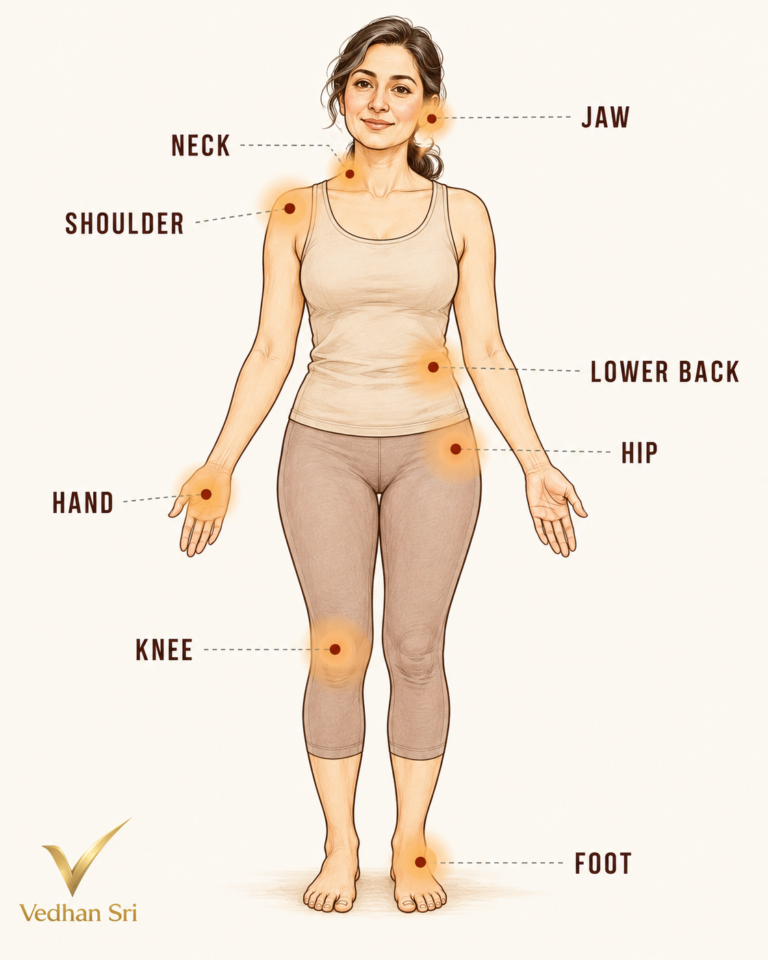
A pattern like this is common in this stage of life. It is still worth mentioning to your doctor — and we will come back to when.
Why Perimenopause Joint Pain May Feel Worse
The honest answer is that nobody fully knows how much is hormonal — and you should be wary of any article that claims otherwise, this one included. But several pieces of the picture are widely discussed:
- Fluctuating estrogen. Estrogen appears to influence inflammation and the health of joint and connective tissue. In perimenopause it does not fall in a straight line; it rises and dips unpredictably, which may be why symptoms can feel like a good week followed by a bad one.
- Broken sleep. Night sweats and restless nights lower the body’s tolerance for pain and slow overnight recovery.
- Held tension. Stress and poor sleep keep the jaw, neck and shoulder muscles braced.
- Less movement. When something aches we move less, and moving less makes joints stiffer. It is an easy loop to fall into.
- Everything else in midlife. Desk work, caring responsibilities, thyroid changes, low vitamin D and ordinary wear and tear all add to the picture.
Not all perimenopause joint pain is hormonal. Joint pain can also come from arthritis, thyroid problems, low vitamin D and other conditions worth ruling out. If your pain is severe, steadily worsening, or comes with swelling, redness or warmth, please see a doctor rather than relying on this article. For a plain overview of the transition itself, the NHS menopause page is a reliable starting point.
Why A Warm-Up Matters More Now
Why it matters. After rest — a night’s sleep, a long meeting — your joints and muscles are at their stiffest. Launching straight into the day, or into exercise, asks cold tissue to do warm work. A warm-up is the bridge. It raises circulation, gently moves the lubricating fluid around each joint, and signals to the nervous system that movement is coming.
What it is. Not exercise. A slow, joint-by-joint sequence of small movements, done well within your comfort.
What happens if you do. The aim is not to erase the ache. It is to take the edge off the first stiff hour, and to give the walk, the yoga class or the strength session that follows a kinder start. Walking, swimming, yoga and strength work are all commonly suggested for joint comfort in this stage of life — a warm-up helps them stay comfortable rather than becoming one more thing that hurts.
What happens if you don’t. The loop stays as it is: cold joints, sharp first movements, a flinch, then avoiding movement altogether.
Three Ground Rules Before You Begin
- Stay at a 3 or 4 out of 10. You are looking for warmth and a feeling of loosening. Sharp, pinching or catching pain inside a joint is the signal to stop.
- Small, slow, smooth. No bouncing and no forcing a range. Half of the movement you could do is plenty.
- Breathe out on the effort. Never hold your breath.
One practical tip: take the chill off first. A warm shower, a warm drink held in both hands, or a minute with your hands under warm running water helps stiff fingers cooperate.
Start with the breath
Everything begins with the breath. In the Saram tradition — the pathway life force travels — the breath is where movement starts. You do not need to hold that belief to try the practice: a slow breath with a longer out-breath than in-breath is a simple way many people settle the body before they move.
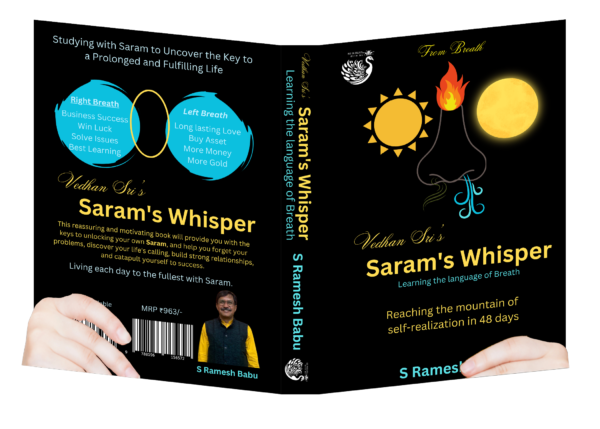
Vedhan Sri’s Saram’s Whisper — The Indian Ikigai
Ikigai is the idea of a reason to rise each morning. Saram’s Whisper is a breath-led Indian answer to it: a 48-day journey through four symbolic mountains, with stories, breath practices and quiet reflections, rooted in Siddha wisdom. Made to be given — for a birthday, a milestone, or a corporate thank-you.
Know a woman who has stopped mentioning her aches and carries on anyway? A book is a quiet way to say: I see you.
₹963
See the bookThe 10-Minute Head-To-Toe Warm-Up
Do this standing, or entirely seated on a firm chair — whichever today allows. Work from the top of the body to the bottom, in this order. Each step names the area it is for.
- 1
Settle The Breath
Stand or sit tall with one hand on your belly. Breathe in through the nose for a count of four, out through the mouth for six. Repeat six to eight times, letting your shoulders drop on every out-breath.
- 2
Unclench The Jaw, Free The Neck
Let your teeth part, lips closed, tongue resting softly behind the upper teeth. Slowly open the jaw as if beginning a yawn, then close — five times. Nod the chin gently down and up five times, then tilt each ear toward its shoulder five times each side. Skip big neck circles; small, slow nods and tilts are kinder. If your jaw clicks painfully or catches, mention it to a doctor or dentist.
- 3
Open The Shoulders
Roll both shoulders backward ten times, then forward five. With fingertips on your shoulders, draw small elbow circles — eight each way. Finish by hugging yourself, then opening the arms wide, six times.
- 4
Wake The Hands
Rub your palms together until warm. Spread the fingers wide, then close into a soft fist — ten times. Touch the thumb to each fingertip in turn, twice through. Circle each wrist eight times in each direction.
- 5
Mobilise The Spine
Hands on your thighs, arch and round the back slowly with the breath, like a cat stretching — eight rounds. Then slide one hand down the side of the leg for a gentle side bend, five each side.
- 6
Circle The Hips
Hands on hips, draw slow circles as if spinning a hoop — eight each way. Then march gently on the spot for twenty steps. Seated: lift one knee at a time.
- 7
Soften The Knees
Hold a counter or chair back. Bend the knees only as far as feels easy — eight small bends — and straighten without locking. Seated: slowly straighten and lower each leg eight times.
- 8
Rouse The Ankles And Feet
Circle each ankle eight times in each direction. Rise onto the balls of the feet and lower — ten times. Roll the sole of each foot over a small ball or a water bottle for thirty seconds.
- 9
Shake Out And Close
Shake out the hands and arms loosely, then the legs. Stand still. Take three slow breaths and notice what has changed — and what hasn’t. That noticing is the skill.
Before your first step (30 seconds, in bed). Heel and arch soreness tends to be worst with the very first steps, so give your feet a minute of movement before they take your weight. Pump and circle each ankle ten times, hug one knee at a time toward your chest, and open and close both hands ten times.
On a flare day. Do steps 1 to 5 seated, add a few ankle circles, and stop. Five gentle minutes beat ten forced ones.
Three Traditional Touch Points To Add At The End
The Siddha tradition of Varmam maps points on the body where gentle touch is used to awaken energy. Three are easy to find, and all three suit this routine. The lightest pressure is the point — a feather touch, a mother’s touch, never force. Spend twenty to thirty seconds on each at the end of your warm-up, and stop if anything feels tender.
| Point | Where it is | What it is traditionally used for |
|---|---|---|
| Ullangai Adangal | Centre of the palm | Energising the hands |
| Ullangaal Vellai Adangal | Centre of the sole of the foot | Supporting energy movement through the whole body |
| Kaakattai Varmam | Four finger-breadths sideways from where the neck meets the shoulder | Many people find it eases neck and shoulder tightness |
If this is new to you, our full guide explains how the points are mapped: What Is Varmam? The Siddha Science Of Pressure Points.

Manifest don’t need your time and speed.

Saram First Reset™ — Five Days Of Guided Practice
Today’s warm-up takes ten minutes. The First Reset teaches what sits underneath it: watching your own breath and listening to what your body has been telling you. Five short days — your first Saram lesson, breath observation, practices for breathing ease and digestive comfort, and family care. No equipment, no flexibility needed.
Start the 5-day reset — ₹499Making It A Habit: A Four-Week Start
A routine you do for four weeks teaches you more than a perfect one you do once. Build it in layers:
- Week 1. Only the 30-second sequence in bed, before you stand.
- Week 2. Add steps 1 to 5 each morning.
- Week 3. The full ten minutes.
- Week 4. Use it before every walk, yoga session or strength session.
Keep a simple diary alongside: how stiff the first hour was (1 to 10), how you slept, which areas ached, and where you are in your cycle. In a month you will have a record that tells you more than guesswork — and one your doctor will welcome.
Four habits that support the same goal
- Keep moving daily. Walking, swimming and yoga keep joints used to motion.
- Build strength twice a week. Stronger muscles share the load that joints would otherwise carry alone.
- Protect your sleep. It is when the body does most of its repair.
- Eat and drink well. Plenty of vegetables, fruit, pulses and water is a sensible default.
When To Pause And Talk To A Doctor
Please get a joint checked promptly if you notice:
- Swelling, redness or warmth in a joint
- Pain that steadily worsens, or wakes you at night
- Morning stiffness that regularly lasts longer than half an hour
- Numbness or tingling, a joint that locks, or sudden difficulty bearing weight
- Fever or unexplained weight loss alongside the aches
If the aches are disrupting your sleep or daily life, it is also worth asking about the options available to you. That is a conversation worth having, and this warm-up sits comfortably alongside whatever you and your doctor decide.
Questions Women Ask
Can perimenopause really cause joint pain?
Joint and muscle aches appear on the symptom lists published by health services, and many women report them. How much is down to hormones is still being studied, and other causes should be ruled out.
How long does it last?
It varies widely from woman to woman, and for some it continues after periods stop. A simple symptom diary will tell you, and your doctor, far more than guessing.
Is it safe to exercise when my joints hurt?
Gentle movement within a comfortable range is generally considered helpful for stiff joints. Sharp or worsening pain is the signal to stop and have it checked.
Is a warm-up enough?
It is a starting point, not a treatment. Think of it as the daily habit that makes everything else — walking, strength work, rest — a little easier to do.
Do I need any equipment?
No. A chair, a counter to hold, and a small ball or bottle for your feet are all you need.
Final Thoughts
Your joints are not betraying you. Perimenopause joint pain is a body in transition asking for a little more care than it used to — not less movement, but gentler, warmer, better-prepared movement.
You do not need ten minutes to begin. Tomorrow morning, before your feet touch the floor, circle your ankles ten times each way. Then see how the first steps feel.
When you want guided practice, start here
The Saram First Reset™ takes you through the foundations in sixteen short videos over five days, self-paced, for ₹499. Finish it and you are a Saram First Reset™ Graduate — the first step on the path.
The movements here are general guidance for healthy adults, not individual medical advice. If you have a diagnosed joint, bone or heart condition, are recovering from an injury, or are unsure whether a movement is right for you, check with your doctor before starting.