
Can Varmam Help After Paralysis? What The Research Shows — And What It Doesn’t
When movement is lost on one side of the body, families ask the hardest question: is there anything else we can try? This is an honest look at what research says about Varmam and Marma, and where it is still silent.
Picture a mother sitting beside her son in a hospital corridor. The scan is done. The doctors have explained. The physiotherapist comes every morning. And still she asks the question I hear most often: is there anything else we can do?
Many people then find their way to Varmam and Marma, the Siddha and Ayurvedic traditions of pressure points. I have given my life to this tradition, so I owe you an honest answer. It is not “yes, it works.” It is not “there is nothing there” either. The truth is more interesting, and more useful, than both.
Why Families Look Beyond The Hospital
Stroke is the most common cause of sudden paralysis. The World Health Organization lists it as the third leading cause of death and disability worldwide, with an estimated 93.8 million people living with its effects in 2021.
In India, the picture from hospitals is sobering. A registry of 34,792 stroke cases from 30 centres, recorded between 2020 and 2022, found that about two in five patients arrived more than 24 hours after symptoms began. At three months, more than half had died or been left with significant disability. Separate mapping work found that only about one in four Indians lives within an hour of a centre that can give clot-busting treatment.
These gaps are real, and they explain why families keep searching. They are also exactly why we must be careful. People in a hard season deserve evidence, not hope sold as fact.
What Varmam Is, And Where It Already Stands
Varmam means pressure points on the body, as understood in the Siddha tradition of South India. It is not only folk memory. India’s national curriculum now includes a postgraduate MD in Varma Maruthuvam, with modules on applied neurology and diseases of the nervous system. The National Institute of Siddha in Chennai lists Varmam treatment for hemiplegia, which is paralysis of one side of the body, and for paraplegia. Hospital records there show that hemiplegia accounted for about 9.4% of inpatients between 2012 and 2023.
Malaysia’s Ministry of Health has also published a practice guideline on Varmam therapy. Look closely at it, though. It covers four conditions: neck and lower-back spondylosis, knee arthritis and frozen shoulder. Stroke is not among them, and the guideline says plainly that it rests on expert consensus.
So recognition and daily use are real. But they tell us that the practice exists, not what it achieves.
A tradition earns trust the way a student does: by showing its work.
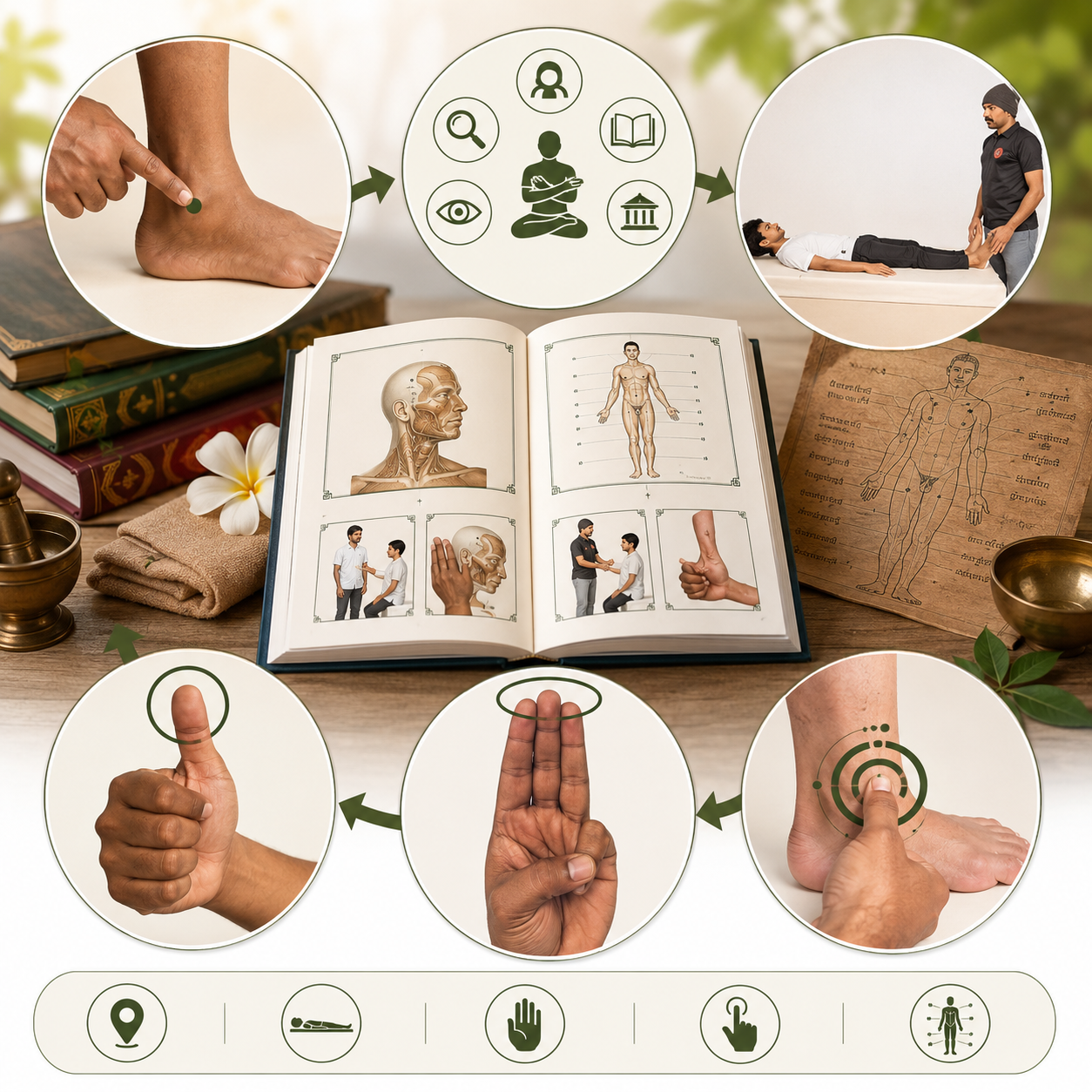
The Varmam Combo — Volumes 1 & 2
159+ Varmam locations and 48 Adangal methods — Adangal being the release techniques of the Siddha tradition — set out in plain language, with the classical source named beside each one. The reference behind everything on this blog.
The Studies We Can Actually Read
Here is every study I could find that comes close to the question, with what each can and cannot tell us.
| Study | What was done | What it suggests | What it cannot tell us |
|---|---|---|---|
| Varmam in hemiplegia, Palayamkottai, 2016 | 20 patients: 10 had internal medicine with Varmam, 10 had medicine alone | “Good relief” in 6 of 10 with Varmam, against 4 of 10 | Very small. How patients were placed in groups is unclear. No blinding is mentioned. |
| Marma therapy after stroke, UK, 2006 | Standard rehabilitation, with or without Marma massage | No clear difference on the main measure. Limb strength and trunk control hinted at benefit. | Not randomized. About 30% dropped out. |
| RESTORE trial, India, 2025 | 140 patients, randomized: Ayurvedic rehabilitation against physiotherapy | The Ayurvedic protocol was not better. It was considered safe. | A different protocol. It was not Varmam. |
Look at the first row with care. Six against four out of ten is a difference of two people. The paper’s own abstract also describes every patient as receiving Varmam, which does not quite match its results. I read it as a signal worth testing, not as proof. Other Siddha papers on hemiplegia are mostly single-patient case reports.
The UK study used a massage form of Marma, a neighbouring tradition rather than Varmam itself. Its authors estimated that about 172 patients would be needed for a definitive trial. I could not find that trial. An unfinished question is not a disproved one. It is simply unfinished.
And RESTORE is a good reminder in the other direction. A well-run trial found that a particular Ayurvedic programme was no better than physiotherapy. That does not condemn Varmam, but it does tell us that tradition alone is not a guarantee.
How Recovery Really Works, And Why It Matters Here
Most early recovery after a stroke happens on its own. In people whose main movement pathway from the brain to the spinal cord is still working, about 70% of the possible improvement in movement returns. That is good news for patients. It is also a trap for treatments, because anything started in the first weeks can look as though it worked. This is why a comparison group matters so much.
What has been shown to help is practice. The 2025 Cochrane review found that rehabilitation improves everyday function, and that functional task training, which means practising real tasks again and again, is likely the most effective approach. Approaches built on other ideas were not better.
There is one more finding worth knowing. A 2025 review of nine studies and 264 patients found that adding somatosensory discrimination training to task practice gave better movement and function than task practice alone. This means learning to tell different touches apart. The patient actively tells the touches apart; it is not passive pressure. Still, it shows why sensation matters for relearning movement, and it is the nearest science comes to explaining how a hands-on approach could help. Whether Varmam does this has not been tested.
Where Varmam And Marma May Fit
My honest position is this. Varmam and Marma may one day prove to be useful companions to medical care and rehabilitation. They are never a replacement for them. The roles worth testing are modest ones: easing muscle tightness, easing pain, building body awareness and keeping the person engaged in their own recovery.
Just as clearly, here is what I cannot say. I found no study showing that Varmam prevents a stroke, stops weakness from becoming paralysis, or repairs damaged brain tissue. If anyone tells you otherwise, ask to see the study.
The test itself is not complicated. Two groups, both given the same hospital care and the same well-dosed rehabilitation. One also receives a standardised Varmam routine. Assessors who do not know who got what measure things like the Fugl-Meyer score and the Barthel Index. And because the question is also about speed, they record how long it takes to the first finger movement, to sitting, to standing and to walking. Until that is done, the honest answer stays “possible, but unproven.”
Learn It In Person — Upcoming Live Workshops
Hands-on, in-person wellness education in JP Nagar, Bengaluru: Supporting the Special Child (14–15 November 2026), with further workshops through January 2027. Places are limited.
What You Can Do Right Now
If someone you love is recovering from a stroke, the most powerful steps are the plain ones. Keep every medicine and therapy session. Ask the rehabilitation team how much daily practice they advise, and whether it is being reached. And look after yourself, because carers who are worn out cannot hold anyone else up.
Three questions are worth asking the team. What is the realistic goal for the next three months? How many minutes of practice should happen each day, and who supervises it? And if we add anything new, whether a therapy, a supplement or a hands-on treatment, what should we watch for?
Saram First Reset™ — Your First Five Days Of Practice
Five short days of breath and body-awareness practice. A calm place to begin, especially if you are the one caring for someone.
A Five-Step Recovery Diary
The Varmam community’s biggest gap is not belief. It is records. You can help in your own household with one page a week.
Keep A Simple Weekly Record
Some weeks the page will show a clear step forward. Some weeks it will show nothing at first. Both are normal, because recovery moves in steps, plateaus and the occasional backward day.
Please look after yourself first. Sudden weakness or numbness on one side, a drooping face, slurred speech or a sudden severe headache needs emergency care at once. Do not wait. Never stop, reduce or delay prescribed medicines or therapy because of anything you read here. Speak to your doctor before trying any hands-on therapy, especially after surgery or where feeling is reduced.
Final Thoughts
Varmam is not an unrecognised practice, and it is not a proven treatment for paralysis. It is a taught, practised and officially recognised system with a few early signals and one large unanswered question. That is a better place to stand than blind belief or easy dismissal.
I would rather tell you “not yet proven” and keep your trust than promise more and lose it. The way forward is patient and ordinary: careful records, fair comparisons, honest results. If this tradition is as valuable as I believe it can be, it will not mind being tested.
Bring Your Questions To Thursday’s Call
Our Inner Circle community call runs every Thursday, 7.30–9.30 PM. It is free and it is live. Write to connect@vedhansri.com to join.
Join Thursday’s call — free Saram First Reset™ · ₹499
The Reset is five short days, self-paced. Most people come to the free call first.
5,500+ students trained · 28+ years of practice · 27+ master teachers learned from · 3 national recognitions
References & Further Reading
- World Health Organization. Stroke (fact sheet). who.int/news-room/fact-sheets/detail/stroke
- ICMR-NCDIR. Stroke patterns, risk factors, management, and outcomes from hospital-based stroke registries in India. PubMed 41502107.
- Geo-spatial analysis of acute ischemic stroke reperfusion treatment in India: an assessment of distribution and access to centers. PubMed 39719435.
- NCISM. Competency-Based Dynamic Curriculum for MD/MS Siddha, Varma Maruthuvam. ncismindia.org/ncism_sem2_SIDPG-AB-VM.pdf
- National Institute of Siddha, Chennai. Varmam section, Pura Maruthuvam. nischennai.org/main/pura-maruthuvam
- Morbidity profiling of patients treated at Ayothidoss Pandithar Hospital of the National Institute of Siddha from 2004 to 2023.
- Ministry of Health Malaysia. Traditional and Complementary Medicine Practice Guideline on Varmam Therapy, first edition, 2016.
- Bhuvaneswari M, Nithiya Prabha C, Kaniraja S. Therapeutic efficacy of varma therapy in hemiplegia: a pilot study. International Journal of AYUSH 2016;5(1):207–211.
- Fox M, Dickens A, Greaves C, Dixon M, James M. Marma therapy for stroke rehabilitation — a pilot study. Journal of Rehabilitation Medicine 2006. PubMed 16801211.
- RESTORE trial of Ayurvedic rehabilitation versus physiotherapy after ischemic stroke, 2025. PubMed 40476511.
- Cochrane Review CD001920 (2025 update). Physical rehabilitation approaches for the recovery of function and mobility following stroke.
- Temporiti F, et al. Effects of somatosensory discrimination training on motor and functional recovery in patients with stroke. Topics in Stroke Rehabilitation 2025;32(7):757–768.
- Moving toward elucidating alternative motor pathway structures post-stroke: the value of spinal cord neuroimaging. Frontiers in Neurology 2024.
- S. Ramesh Babu, Varmam – An Insight into the Ancient System of Healing: A Symposium on the Science of Life Force, Volume I (Revised Edition) and Volume II.
This is wellness education, not medical treatment. It does not replace advice from your doctor. Results vary from person to person.
Tell us in the comments below. If you have ever walked beside someone relearning to move, what was the smallest moment — a finger, a first step, a steadier breath — that told you something was changing?