
Why Are You So Sensitive To Everything?
The light feels too bright. The comment sits with you for hours. Your heart moves before you decide anything. None of that means something is broken — it means your nervous system is doing exactly what it evolved to do.
Someone says one sentence and you feel it in your chest for the rest of the day. A door slams two rooms away and your shoulders jump before you’ve had a single thought about it. You walk into a loud, bright room and within a minute you are tired in a way that has nothing to do with sleep.
If you have ever wondered whether you are “too sensitive”, this article is for you. The short answer is: you have a nervous system that is constantly sensing, interpreting, predicting and adapting — and some of what it does happens before your thinking mind is even in the room. That is not a flaw. It is the same system that keeps your heart beating, your lungs breathing and your balance steady without you ever giving it an instruction.
This is a long read, written plainly, and checked against the current science rather than the version of it that travels fastest online. We will also, near the end, bring in something this website exists for — where a much older tradition, the breath science of Saram (Saram — the Siddha breath tradition Vedhan Sri teaches) and the pressure-point science of Varmam (Varmam — the Siddha tradition’s map of the body’s vital points), asks some of the same questions in a different language.
1. Your Nervous System Is An Extraordinary Communication Network
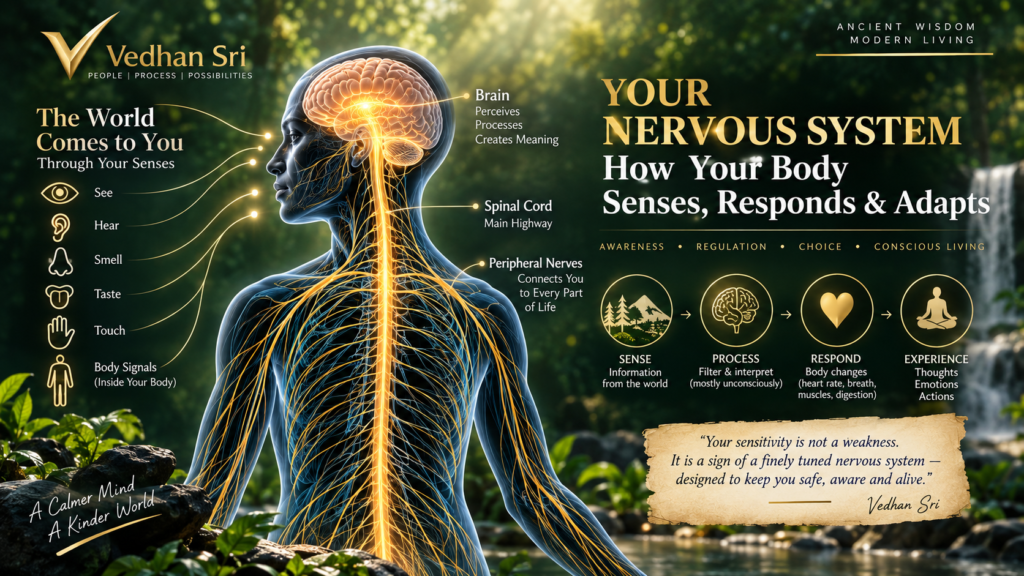
Your nervous system is built from three working parts. The brain plans, interprets and decides. The spinal cord is the main cable running down your back, carrying signals both ways between brain and body. The peripheral nerves branch out from that cable into every part of you — skin, muscles, organs, glands.
All of it is built from neurons — nerve cells that pass signals to each other across tiny gaps called synapses. The human brain has an estimated 86 billion neurons, a figure established by counting studies in the last two decades; the older, popular “100 billion” was a rounded estimate from before that counting method existed, and is still repeated everywhere even though it is not the most precise number we have. A single neuron can connect to thousands of others, which is part of why a system built from a “mere” 86 billion cells can do so much.
Layered on top of your brain and spinal cord is the autonomic nervous system — the part that runs your heart rate, breathing, digestion and alertness automatically, without you supervising it. It is the part this whole article is really about.
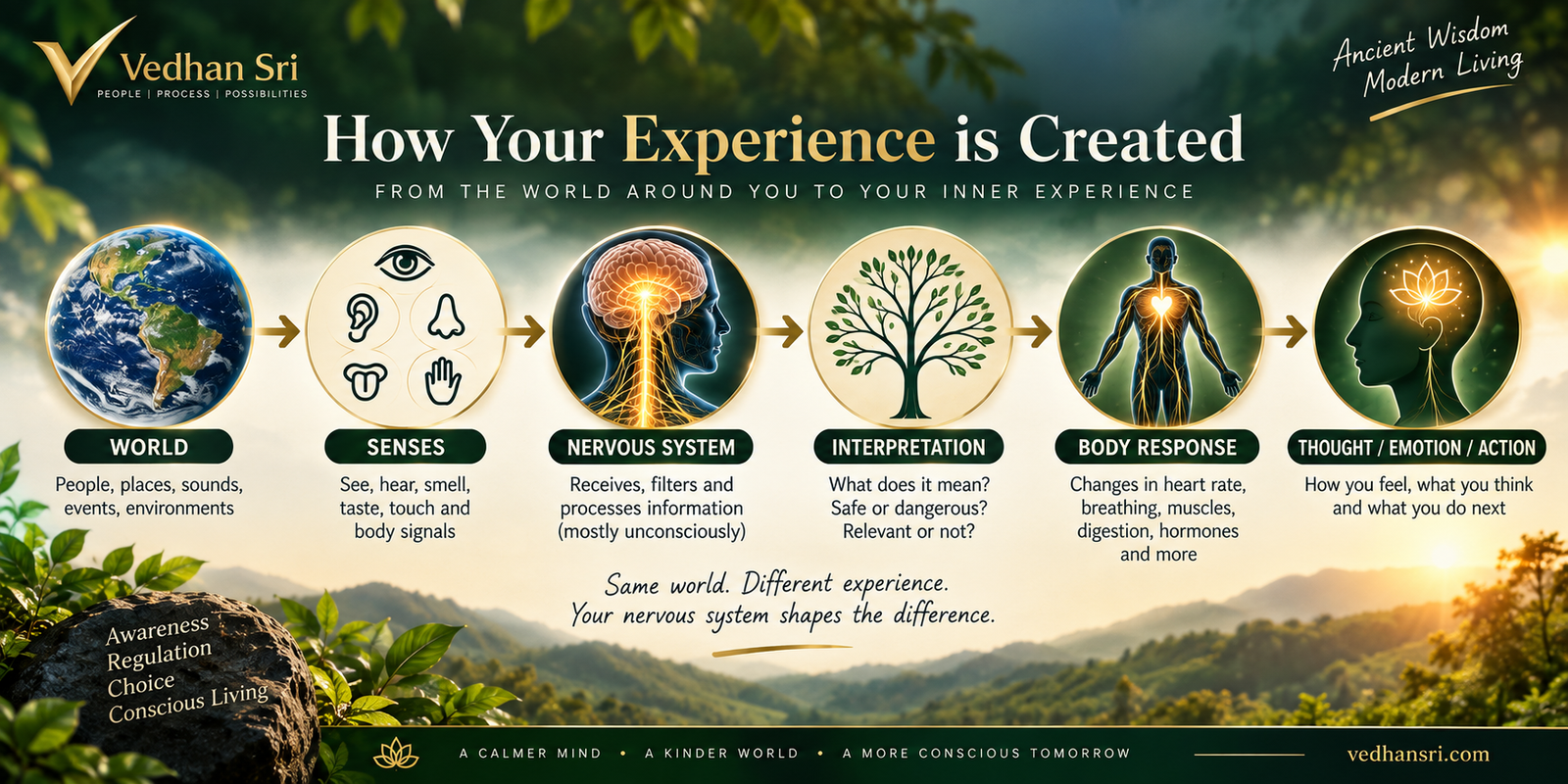
Here is the basic loop, in the simplest form we can put it:
Your senses take in a genuinely enormous amount of information every second — far more than you could ever consciously attend to. Careful recent work on this question (Zheng & Meister, 2024) puts conscious, deliberate thought at a strikingly slow rate — on the order of 10 bits per second — against a sensory intake that runs to roughly a billion bits per second. The exact numbers you may have seen elsewhere (“11 million bits a second, conscious processing just 50”) come from a much older, rougher 1986 estimate that is still widely repeated online. The precise figures differ depending on which study you read; the point that survives every version of this research is the same one your own experience already tells you — your body is taking in far more than your conscious mind ever directly processes. Something has to filter that gap. That something is largely automatic, and it is a large part of why the world can feel like “a lot” even when nothing is technically wrong.
2. Survival Comes Before Comfort
Your nervous system did not evolve to make you comfortable. It evolved to keep you alive long enough to pass that nervous system on. Comfort, when it happens, is a fairly recent bonus on top of a much older survival job.
That is why a whiff of potential threat — a raised voice, a fast movement in the corner of your eye, an unfamiliar smell — can shift several things at once, before you have consciously registered why:
- Heart rate, up or down
- Breathing, faster and higher in the chest
- Muscle tension, especially through the neck, jaw and shoulders
- Attention, narrowing sharply onto the possible source
- Digestion, often slowing or pausing
- General alertness, rising even if you look outwardly calm
This is the classic split between two branches of the autonomic nervous system. The sympathetic branch tends to mobilise the body — more fuel, more heart rate, more readiness to act. The parasympathetic branch tends to do the opposite — rest, digestion, recovery, slower heart rate. In real life they are not a simple on/off switch; both are active all the time, in different proportions, constantly adjusting. Think of it less like a light switch and more like two hands on a single steering wheel.
YOUR NERVOUS SYSTEM DOESN’T JUST RESPOND TO THE WORLD.
IT HELPS SHAPE HOW YOU EXPERIENCE IT.
3. What Is Neuroception?
In the 1990s, researcher Stephen Porges coined the term neuroception for something like “threat detection that happens before you consciously think about it” — your body registering a room, a face or a tone of voice as safe or unsafe before you have formed a single deliberate thought about it.
Neuroception is part of Polyvagal Theory, a framework Porges built around the idea that the autonomic nervous system moves through three broad states — socially engaged and calm, mobilised for fight-or-flight, and, at the extreme, a shutdown or freeze state. It is worth being honest about where this framework stands scientifically. Polyvagal Theory is widely used in therapy and bodywork because it gives people a useful, humane way to talk about states they can feel but struggle to name. It is also genuinely contested among physiologists and neuroanatomists, who have raised specific objections to some of its anatomical claims and to how reliably its proposed measurements track what it says they track. Our honest position: neuroception is a useful concept for noticing that a lot of safety-and-threat evaluation happens outside conscious awareness. Treat the three-state map as a helpful way of talking, not as a settled anatomical fact.
4. The Vagus Nerve: Brain–Body Communication
The vagus nerve is one of the body’s longest nerves, running from the brainstem down through the neck and chest into the abdomen. Along the way it connects with the heart, the lungs and most of the digestive tract, carrying signals in both directions — the majority of its fibres, in fact, carry information up from the body to the brain, not just orders going down.
It is a genuinely central player in the parasympathetic, “rest and digest” side of the autonomic nervous system — involved in slowing the heart rate, supporting digestion, and helping the body come back down after activation.
What it is not is a single switch you flip. You may have read that one slow exhale “activates the vagus nerve” like a reset button. That is an overstatement of a real and useful phenomenon. What the evidence more carefully supports is this: slow, comfortable breathing — particularly breathing with a somewhat longer exhale than inhale — is associated with changes in heart-rate variability and can nudge the nervous system toward a calmer state. It is an influence, built up with practice, not an instant override.
5. Why Stress Can Be Felt In The Body
You have almost certainly noticed stress show up as a tight jaw, a knotted stomach, shallow breathing, or a back that will not quite release. This is real, and it deserves an accurate explanation rather than a dramatic one.
A popular version of this idea says that “trauma is stored” directly inside your fascia, muscles or organs, as if a memory were a physical object hidden in tissue. We are not going to repeat that as established biology, because it is not. What current research does support is more modest and, if anything, more useful: repeated stress and difficult experience can shape muscle guarding (habitually bracing certain muscles), interoception (how accurately and how anxiously you read your own internal signals), learned associations between certain situations and certain body states, and knock-on effects on breathing, sleep and pain sensitivity. The body remembers through learned patterns of response, not through hidden objects lodged in your tissue.
Chronic stress also involves real, measurable chemistry — cortisol and adrenaline (epinephrine) among the most discussed. These do not behave identically: adrenaline is fast in and fast out, with blood levels typically falling within minutes once the trigger passes, while cortisol is slower to rise and slower to clear, with effects that can linger for an hour or more. You may also have read that chronic stress “shrinks” the hippocampus or “enlarges” the amygdala. Research does show associations between chronic stress and changes in these regions across groups of people studied over time — this is a real and active area of study — but it is a step too far to tell any one person that their brain has definitely changed shape because of their particular stress. Treat this as an area of ongoing research, not a diagnosis you can make about yourself.
6. Your Gut And Nervous System Communicate
Your gut has its own extensive local nervous system, the enteric nervous system, often estimated at somewhere in the hundreds of millions of neurons — sometimes called the body’s “second brain”. It communicates constantly with the brain in both directions, a relationship researchers call the gut–brain axis, and your gut microbiome appears to be part of that conversation too.
You may have read that the gut “produces 95% of the body’s serotonin and 50% of its dopamine”. The 95% serotonin figure is well supported — the great majority of the body’s serotonin genuinely is made in the gut, mostly by specialised gut cells. The gut dopamine figure is repeated constantly online but is far less rigorously established in the scientific literature; it should be treated as a popular estimate rather than a settled number.
The detail that matters most is one that popular articles usually skip: gut-made serotonin does not simply cross into your brain and become “mood serotonin”. The blood–brain barrier keeps most of it out. Gut serotonin does real work — in digestion, and in signalling back to the nervous system through the gut wall and the vagus nerve — but it is not accurate to say your gut is directly supplying your brain with its mood chemicals. The gut–brain axis is real and important; it works through signalling pathways, not through direct chemical hand-off.
7. The Brain Learns Patterns
One of the most useful ideas in all of neuroscience is neuroplasticity — the brain’s ability to change its own wiring in response to experience, at any age, not only in childhood.
A famous shorthand for one part of this, known as Hebbian learning, is:
“Neurons that fire together wire together.”
When a pattern of thought, feeling or reaction happens often enough, the neural pathway underneath it tends to become easier to activate — a well-worn path is easier to walk than fresh ground. This explains why a reaction you have had a thousand times can feel automatic.
The hopeful other half of neuroplasticity is just as real: the nervous system remains capable of learning new patterns, at any age. Old paths do not vanish overnight, but new ones can be built alongside them with enough consistent practice. This is the scientific basis for the idea that regulation is a skill you can build, not a trait you either have or lack.
Learn It In Person — Upcoming Live Workshops
If this article has you thinking about someone in your own life whose everyday movement has changed, Vedhan Sri teaches this work hands-on in Bengaluru — practical, careful ways to support comfort, mobility and everyday independence at home. Supporting the Special Child runs 14–15 November 2026, and further workshops run through January 2027. Places are limited.
This is wellness education, not medical treatment. It does not replace advice from your doctor. Results vary from person to person.
8. Why You May React Before You Can Think
Some threat-related processing genuinely happens faster than conscious thought. Careful lab studies using fear-related faces have measured amygdala responses as fast as around 74 milliseconds after a stimulus appears — well under a tenth of a second, and well before a person can report having consciously seen anything. You may have seen a specific, smaller figure (around “12 milliseconds”) circulating online; we could not verify that exact number against the published research, so we are giving you the figure that is directly supported by peer-reviewed measurement instead.
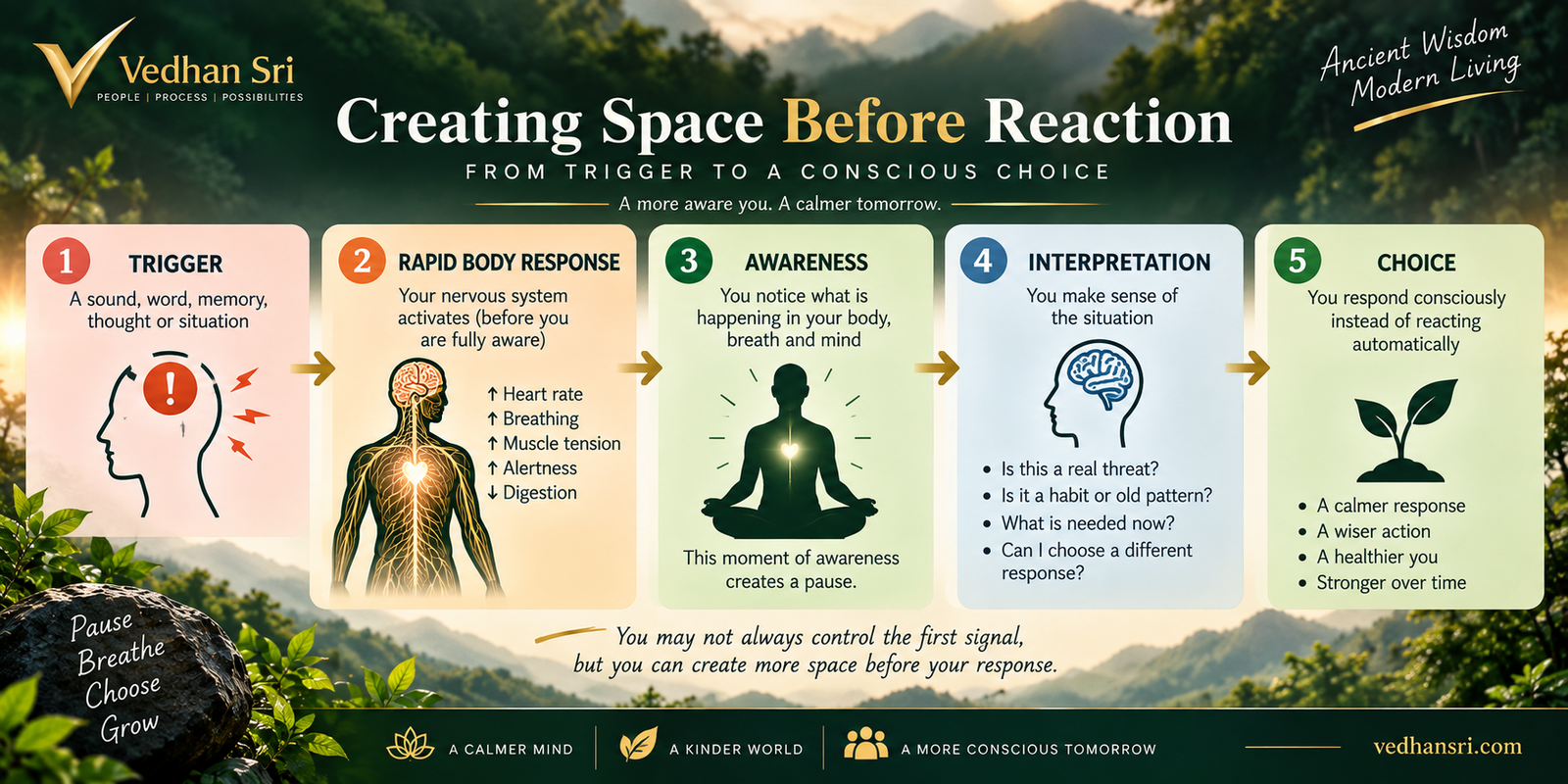
This is also why vividly imagined, remembered or anticipated situations can trigger some of the same physiological stress response as a real external threat — replaying an argument in your head can raise your heart rate almost as effectively as the argument itself. It is not accurate to say the nervous system “cannot tell the difference” between real and imagined threat, as if it were simply confused. It is more precise to say that imagination and memory can activate genuinely overlapping physiological systems, which is a related but different claim.
Training does not necessarily remove the first signal. It can create more space between signal and response.
9. Connection Changes Physiology
Human beings are social nervous systems as much as individual ones. A steady voice, a calm face, a felt sense of safety in another person’s presence — these can measurably shift your own physiology, a process sometimes called co-regulation. This is one reason a difficult moment can feel entirely different depending on whether you face it alone or with someone steady beside you.
Facial expression, vocal tone and appropriate touch all appear to carry real signalling weight in this process. What we will not claim is that “mirror neurons” — brain cells that appear to activate both when you act and when you watch someone else act — fully explain something as complex as generational trauma passing through families. Mirror neurons are a real and interesting finding, but the transmission of patterns across generations involves learned behaviour, environment, relationship modelling and very likely epigenetic factors still being researched — a much wider picture than one cell type can carry on its own.
10. Pain Is More Than Tissue Damage
Nociception — the raw detection of potentially damaging stimulation by nerve endings — is not the same thing as pain, which is what your brain constructs once it interprets that signal alongside memory, emotion, attention and context. This is why the same injury can hurt differently depending on the day, and why pain can persist after tissue has visibly healed, a phenomenon researchers describe as central sensitization — the nervous system itself becoming more reactive to signals over time.
Pain is real even when the amount of pain does not directly correspond to the amount of tissue damage.
This is not a claim that pain is “just in your head” in the dismissive sense people sometimes mean by that. It is closer to the opposite: pain is a genuine, whole-nervous-system event, and treating it that way opens up more ways to influence it, not fewer.
11. The Nervous System Can Change
This is the turning point in the article, and it is a genuinely hopeful one. Regulation is not the absence of stress. It is the nervous system’s capacity to respond when something happens, and then to recover afterward — a skill, not a permanent state.
REGULATION IS NOT “NEVER FEELING STRESS.”
IT IS THE CAPACITY TO RESPOND AND RECOVER.
A reasonable, evidence-informed list of things that support this capacity, none of them exotic:
- Slower breathing, especially a somewhat longer exhale than inhale
- Regular sleep
- Movement and exercise, of whatever kind you can sustain
- Daylight exposure, particularly earlier in the day
- Predictable routines, especially during difficult periods
- Supportive relationships and safe company
- Mindfulness and interoceptive awareness — noticing what is happening in the body without immediately reacting to it
- Appropriate professional support, when the situation calls for it
None of this is a promise of a permanently calm nervous system — no honest article can offer you that. It is a description of a system that remains capable of learning, throughout your life.
12. Where Traditional Breath Practices Enter The Conversation
Everything so far has been building toward one practical question: if so much of this happens before conscious thought, where do you actually place your attention first? Neuroscience keeps pointing to the same answer — the breath. It is one of the very few processes in the entire autonomic system in section 2 that you can also run on manual control. Slow it deliberately, with a somewhat longer exhale, and you are reaching directly into the sympathetic/parasympathetic balance described earlier, and into the vagal pathways described in section 4. That is the bridge from nervous-system awareness to breath awareness, and it is also, not coincidentally, where a much older tradition already started.
Long before anyone had the word “neuroplasticity”, the Siddha tradition of South India was already paying close attention to breath, state and the body’s vital points. Swara is the older Siddha science of breath and its rhythms; Saram is the breath-science practice built on that foundation, which Vedhan Sri teaches; Vaasi (also written Vasi Yogam) is a related breath-and-yoga discipline; and Varmam is the Siddha map of the body’s vital points, the subject of most of the other articles on this site. Each of them starts from the same instruction this article has been building toward: notice the breath before trying to change anything else.
It would be tempting, and dishonest, to claim that Saram and modern nervous-system science are describing one identical mechanism in two vocabularies. We are not going to claim that, and the distinction is worth stating plainly rather than glossing over. Modern neuroscience works by measurement — nerve conduction studies, heart-rate variability, controlled trials, the kind of evidence cited throughout this article. Siddha breath science works by direct, guided practice, passed from teacher to student over generations and refined by sustained observation rather than instrumentation. Both are real, disciplined ways of knowing something about breath and state. Neither is a translation of the other, and this article is not going to pretend otherwise.
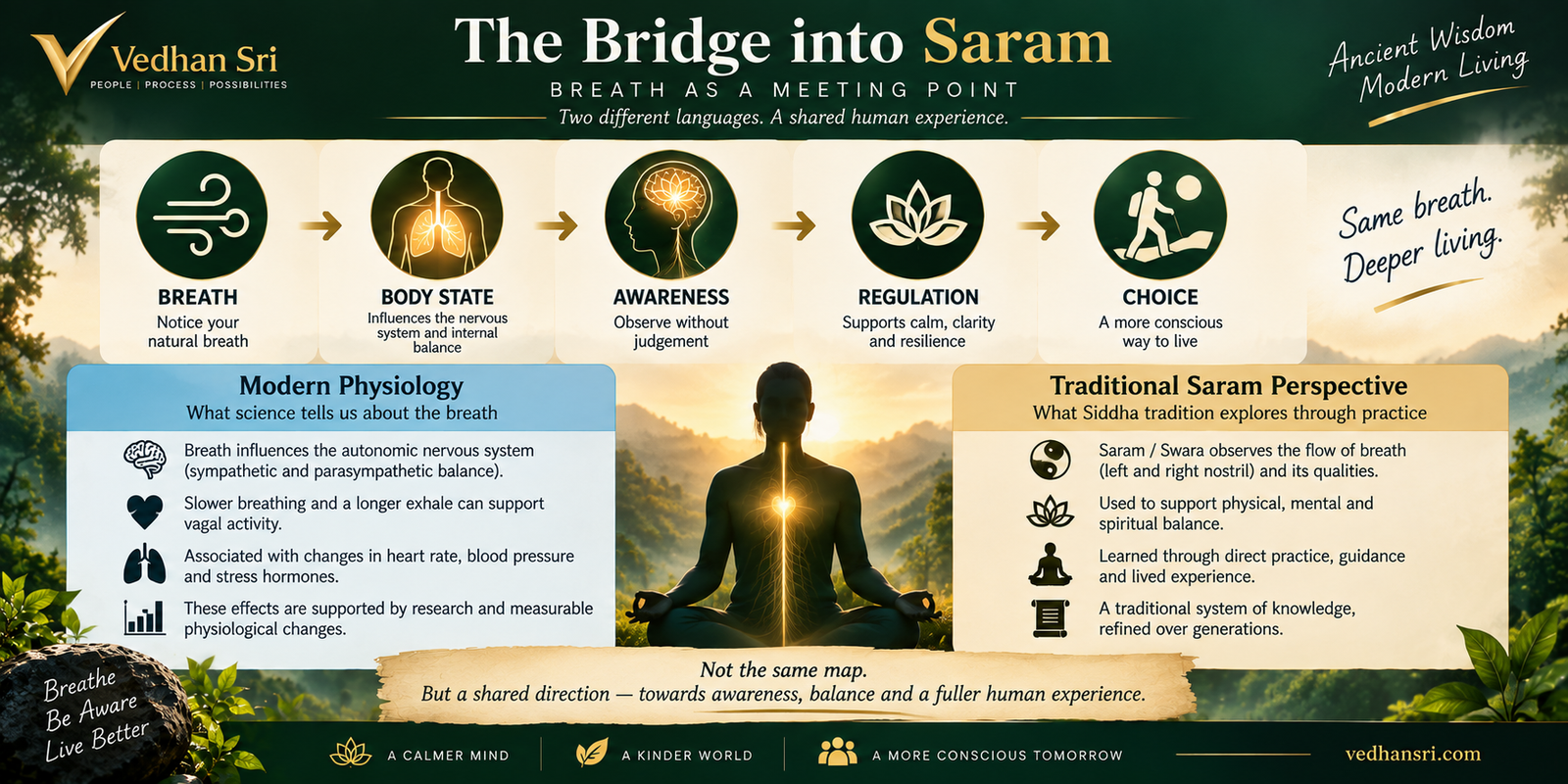
Two different languages asking some overlapping questions about breath, state, awareness and the human body.
What both languages agree on, in their own terms, is where a person actually starts: not by forcing the breath into a new shape, but by noticing it honestly first. That is the exact order this article has followed — nervous system, then breath, then practice — and it is also the order Saram itself teaches. If you want to see how this website turns that starting place into a structured path, the Saram Living path lays out how the free community material, the Saram First Reset™ and the deeper programmes fit together, and Saram’s Whisper is Vedhan Sri’s own account, in his own words, of why breath became central to this work. For the pressure-point side of the tradition specifically, our plain-English guide to Varmam is the right next stop, and the full course paths page lists where to begin if you want structured, guided practice rather than a single article.
13. A Simple 60-Second Awareness Practice
No forced breathing. No breath holding. Just noticing, for about a minute, seated comfortably wherever you are.
Before trying to change your nervous system, learn to notice it.
14. Your Nervous System Is Not Your Enemy
Every reaction described in this article — the jumpy shoulders, the tight jaw, the racing thoughts before you have even decided to think them — is a protective system doing its job, not proof that something in you is broken. A nervous system that responds to the world is a working nervous system. The goal was never to stop it from responding. The goal is choice: more space, more often, between what happens and what you do next.
Before trying to control your nervous system, learn to observe it. Begin with the breath.
That is exactly where Saram starts. The Saram Living path and Saram’s Whisper pick up from precisely this point — not as a replacement for the science above, but as a practice built, in its own tradition and on its own terms, on the same starting instruction this article has followed throughout: notice first.
Frequently Asked Questions
What does nervous system regulation mean?
It means having a nervous system that can respond when something happens — stress, a surprise, a demand — and then recover afterward, rather than staying stuck in activation or shutdown. It is a capacity you build, not a permanently calm state you reach once and keep forever.
What are signs of an activated stress response?
Common signs include a faster heart rate, quicker or higher breathing, tight jaw or shoulders, a narrowed focus of attention, digestive changes, and a general sense of alertness or unease. These are normal sympathetic-nervous-system signs, not evidence that something is medically wrong on their own.
Can breathing influence the autonomic nervous system?
Yes. Slower, comfortable breathing — especially with a somewhat longer exhale than inhale — is associated with changes in heart-rate variability and can support a shift toward a calmer state. It is an influence you build with practice, not an instant switch.
What does the vagus nerve do?
It is one of the body’s longest nerves, running from the brainstem to the heart, lungs and digestive tract, carrying signals in both directions. It plays a central role in the “rest and digest” side of the nervous system, though it is not a single on/off switch for calm.
Can the nervous system change through neuroplasticity?
Yes, at any age. Repeated patterns can become easier to trigger over time, but the nervous system keeps its capacity to learn new patterns throughout life, which is the basis for regulation as a trainable skill.
What is the difference between Saram/Swara and modern nervous-system science?
They are two different languages asking some overlapping questions about breath, state, awareness and the human body. Saram and Swara come from the Siddha tradition and describe practice and experience; modern neuroscience describes mechanism and measurement. Neither replaces the other, and this article does not claim they are the same system.
References & Further Reading
- Herculano-Houzel, S., “The Human Brain in Numbers: A Linearly Scaled-up Primate Brain”, Frontiers in Human Neuroscience, 2009 — PubMed 19915731 — on current best estimates of total neuron count (≈86 billion).
- Zheng, J. & Meister, M., “The Unbearable Slowness of Being: Why Do We Live at 10 Bits/s?”, Neuron, 2024 — PubMed 39694032 — on conscious processing speed versus sensory intake.
- Méndez-Bértolo, C. et al., “A Fast Pathway For Fear In The Human Amygdala”, Nature Neuroscience, 2016 — DOI: 10.1038/nn.4324 — on rapid (≈74ms) amygdala responses to fear-relevant stimuli.
- “Gut Serotonin as a General Membrane Permeability Regulator” — PMC9413787 — on the proportion of body serotonin produced in the gut and why it does not directly cross into the brain.
- Porges, S.W., “Orienting In A Defensive World: Mammalian Modifications Of Our Evolutionary Heritage. A Polyvagal Theory”, Psychophysiology, 1995 — the origin of neuroception and the polyvagal framework; and Grossman, P. et al., “Why The Polyvagal Theory Is Untenable: An International Expert Evaluation”, Clinical Neuropsychiatry, 2026 — PubMed 41768017 — the peer-reviewed critique behind this article’s “contested framework” framing.
- Xie, L. et al., “Sleep Drives Metabolite Clearance From The Adult Brain”, Science, 2013 — PMC3880190 — on sleep-associated brain waste (glymphatic) clearance.
- Woolf, C.J., “Central Sensitization: Implications For The Diagnosis And Treatment Of Pain”, Pain, 2011 — PMC3268359 — on nociception, pain and central sensitization.
- Hebb, D.O., The Organization of Behavior, 1949 — the original source of Hebbian learning (“neurons that fire together wire together”); this predates DOI/PubMed indexing, so it is cited here as the historical source rather than linked.
Bring your own nervous system to a live call
Our Inner Circle community call runs every Thursday, 7.30–9.30 PM. It is free and it is live. If this article raised questions about your own patterns, that conversation is the natural next step before any programme. Write to connect@vedhansri.com to join.
Join Thursday’s call — free Saram First Reset™ · ₹499
The Reset is five short days, self-paced, and starts with exactly the breath-and-awareness ground this article covers.
5,500+ students trained · 28+ years of practice · 27+ master teachers learned from · 3 national recognitions
This article draws on current, publicly available neuroscience research and is written to fact-check and appropriately qualify popular claims about the nervous system — see References & Further Reading above. Where a commonly repeated figure could not be verified against peer-reviewed sources (for example, an exact “12 millisecond” amygdala response time, or a precise “45 miles of nerve fibre” total), it has been replaced with the closest figure we could verify, or presented as an estimate rather than a fact. Polyvagal Theory concepts (neuroception, the three-state model) are presented as a widely used clinical framework, not as settled neuroscience. Sri Ramesh Babu (Vedhan Sri) is Founder Trustee of Varma Kalpa Rejuvenation Center.