
Your Knees Are Telling You About Your Hips And Ankles
Going up is fine. It is coming down that makes you reach for the railing — and knee pain going down stairs is the part nobody thinks to mention to anyone.
Notice how specific the complaint is.
Not “my knees hurt”. It is descending stairs. Standing up from the floor after sitting cross-legged. The first three steps after a long drive. Getting out of a low car.
Those four moments have something in common, and it is not the knee. That shared thread sits behind most knee pain going down stairs.
The Knee Is A Hinge Between Two Joints It Does Not Control
Your knee bends and straightens. That is very nearly all it does. It does not rotate meaningfully, it does not tilt, it has almost no say in which direction it faces.
The hip above it decides that. The ankle below it decides that.
So when you come down a step, the knee is not choosing the angle it lands at — it is accepting one. If the hip is stiff from a day of sitting, or the ankle has lost a little range and no longer lets the shin travel forward over the foot, the knee absorbs the difference. Every step. Both directions. All day.
Going up is easier because the hip and the big muscles at the front of the thigh do most of the lifting. Coming down is harder because something has to control the fall, slowly, under load — and the knee is the joint holding the brake.
What The Classical Map Does With The Leg
Here is the detail that made me look at knees differently, and it is a matter of simple counting.
Sushruta’s Sharira Sthana lists twenty-two marma in the lower limbs — eleven on each leg, from the sole of the foot to the groin. Sole, the web between the big and second toe, the arch, the heel, the ankle, the calf, the knee, just above the knee, the mid-thigh, the top of the thigh, and the groin.
Eleven points per leg. Exactly one of them is the knee.
Read the list upwards and downwards. The classical map does not treat the knee as a destination. It treats it as somewhere on a line that runs from the floor to the hip, with markers on either side of it.
And it measures those markers the way it measures everything — in your own finger-widths from a bone you can feel. Ani is three fingers above the knee. Not three centimetres. Three of your fingers, so a tall person and a short person following the same instruction each land in the right place on their own frame.
What Siddha does here, and what it honestly does not
The Siddha side maps the leg as its own region: Varma Beerangi places fifteen of the hundred and eight varmam points in the lower limb.
I am not going to name them for you, and I want to be straight about why. The Siddha literature I work from documents the upper limb in detail — a 2022 review from the National Institute of Siddha gathered thirty-three arm and shoulder points with the source text named for each. For the lower limb, what I have is the count, not a verified list. Naming a knee point I cannot trace to a text would be exactly the kind of thing this blog exists to avoid.
What both traditions plainly agree on is the shape of the thing: fifteen points in one leg, eleven in the other tradition’s reckoning, and in neither case is the joint that hurts treated as the whole story.

Both maps ring the knee rather than aim at it. The load arrives from either side.
Why A Ring And Not A Target
Both of these were injury maps long before they were healing maps. Sushruta calls the study of marma half the whole science of surgery, and the Siddha points came out of the Tamil martial tradition. Knowing where a body is vulnerable is the same knowledge as knowing where it is load-bearing — the two traditions simply inverted it.
Which is why the arrangement is worth reading as engineering rather than mysticism. Points cluster where forces converge and where several kinds of tissue have to negotiate with each other. Around a hinge that takes the load from two directions, you would expect to find markers on both approaches. That is exactly what is there.
This is the same lesson as Thursday’s post on the lower back and Friday’s on the shoulder, arriving for the third time in a week: the loud joint is rarely the one that started the conversation.
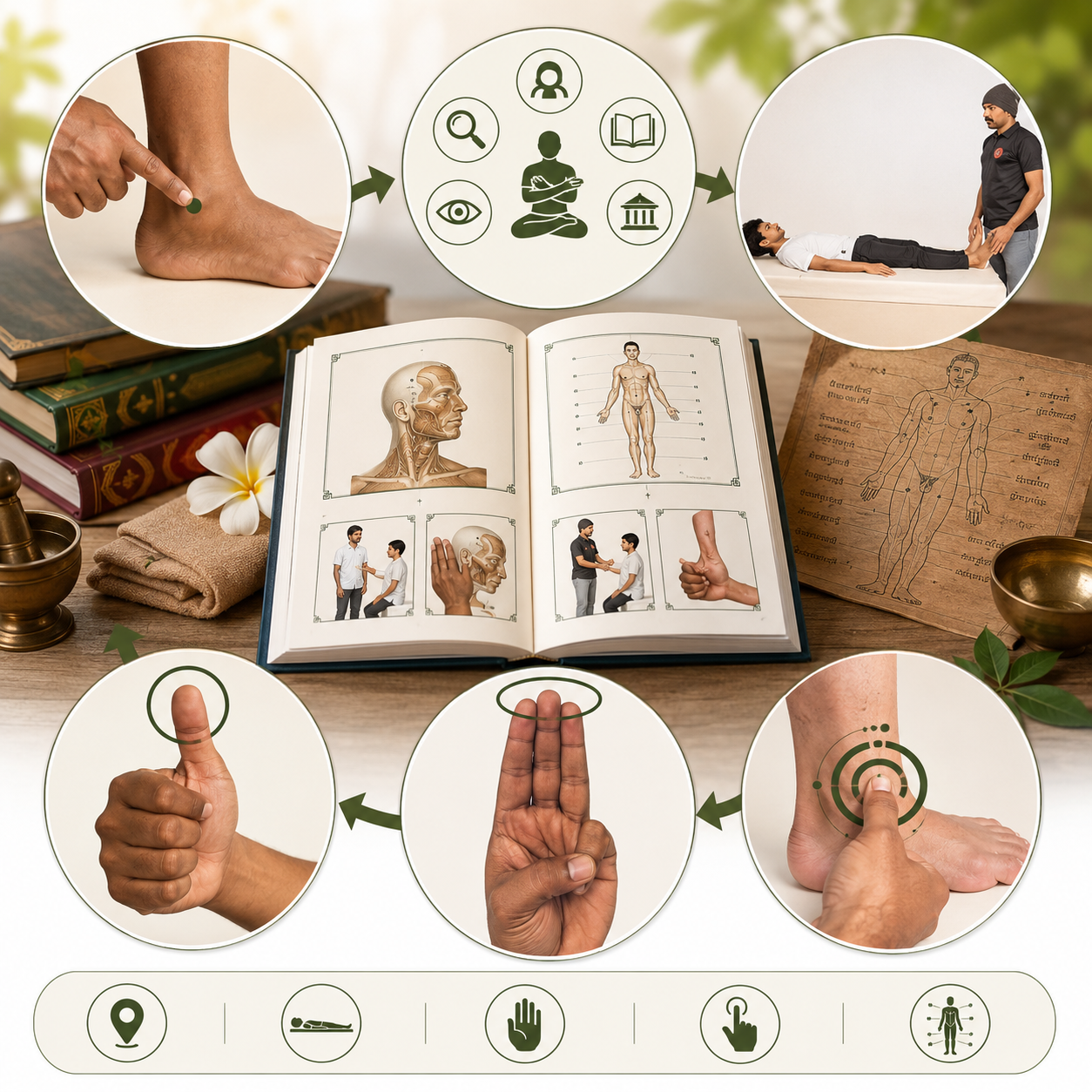
The Varmam Combo — Volumes 1 & 2
159+ Varmam locations and 48 Adangal methods — Adangal being the release techniques of the Siddha tradition — written out in plain language, with the classical source named beside each one. The reference book behind everything on this blog.
The Practice: Work The Neighbours, Not The Knee
Two minutes, once or twice a day. Nothing here touches the knee — yet it is where I begin with knee pain going down stairs.
- Sit at the front of a firm chair, feet flat on the floor. Not a sofa. You want a seat that does not swallow you.
- Ankle circles. Lift one foot slightly and draw ten slow circles with the toes, then ten the other way. Repeat with the other foot. Slow enough that you can feel the shape of the circle, not fast enough to be a warm-up.
- Both feet down, directly under your knees, weight spread through the heel and the ball of the foot rather than tipping in or out.
- Stand up without using your hands, taking about three seconds, breathing out the whole way up. If you need your hands, use them — and use them a little less next week.
- Sit back down twice as slowly as you stood. That controlled lowering is the thing stairs are asking you for. Five repetitions.
The lowering is the whole exercise. Standing up is the easy half and most people rush the sit. Going down slowly, under control, in a chair where the worst outcome is landing early, is a rehearsal for the staircase where it is not.
What To Expect, Honestly
When knee pain going down stairs is the complaint, the ankles usually loosen first — often within a week, because they are simply out of the habit of being moved through their full range. Whether the knee itself feels different is far less predictable. Some people notice the railing becoming optional. Some notice nothing at all, and that is worth knowing before you begin rather than after.
What the practice reliably gives you is information. If your ankle will not circle smoothly, or one side circles further than the other, or standing up unaided is genuinely hard — those are useful facts about your legs that you did not have this morning, and they are more actionable than the pain itself.
When this post is not about your situation
If your knee locks, gives way or catches; if it swelled suddenly; if you cannot put weight on it; if it is red, hot and you feel unwell with it; if the pain followed a twist, a fall or a sporting injury; or if you have pain, swelling or warmth in one calf — do not do this practice, and see a doctor. Some of those need attention today rather than eventually. Traditional practices sit alongside proper medical care. They never sit in front of it.
Final Thoughts On Knee Pain Going Down Stairs
Eleven points on a leg, and one of them is the knee. Two above it, two below it, and a hinge in the middle that mostly does what it is told by the joints on either side.
Your knee is not the author of this complaint. It is the joint that files the report, because it is the one holding the brake when you come down the stairs.
Circle your ankles. Stand up slowly. Sit down more slowly still.
Bring the specific moment to a live call
Our Inner Circle community call runs every Thursday, 7.30–9.30 PM. It is free and it is live. Knees are one of the most common things people bring, and the useful conversation is always about the specific moment — which step, which direction, which leg. Bring yours. Write to connect@vedhansri.com to join.
Join Thursday’s call — free Saram First Reset™ · ₹499
The Reset is five short days, self-paced. Most people come to the free call first.
5,500+ students trained · 28+ years of practice · 27+ master teachers learned from · 3 national recognitions
Sources for this article: Sushruta Samhita, Sharira Sthana ch. 6, as tabulated in Mishra A. & Shrivastava V., “Exploring the Science of Marma — Part 2: Definition and Properties”, Dev Sanskriti Vishwavidyalaya, 2020 — the twenty-two lower-limb marma and the documented locations and sizes of Urvi, Ani, Janu, Indravasti and Gulpha. Krishnapriya D., Mahadevan M.V. & Muthukumar N.J., IJCRT Vol 10 Issue 11, November 2022, National Institute of Siddha, Chennai — the upper-limb Varmam documentation and the Varma Beerangi regional counts. Sri Ramesh Babu (Vedhan Sri) is Founder Trustee of Varma Kalpa Rejuvenation Center.