
Why Some Varmam Points Are Called ‘Time’: Reading The Names In The Old Verse Books
Open an old Varmam verse book and the contents page reads like a strange guest list: Kaalam, Kolli, Adangal. Here is what those words meant to the people who wrote them — and where the books honestly disagree.
Most people meet Varmam through a number: 108 points. It is a tidy, memorable figure, and it is where almost every introduction begins. But if you sit with the old Tamil verse books themselves, you quickly find that the names tell you far more than the number does.
Take one small verse book, Varma Peerangi. Its contents page lists 104 numbered entries. By a simple count of the names, roughly forty end in the word Varmam, thirty-seven end in Kaalam, two end in Kolli, and the rest are oils, decoctions and section headings — including four sections simply titled Adangal.
Why would one art use so many different endings? This post follows that question through the books, and it is a companion to our longer history of where Varmam comes from, from the Vedas to Kanyakumari. Where the record is firm we say so, and where the books disagree with each other we show you both sides.
Why The Names Matter More Than The Number
The number turns out to be less fixed than it looks. Ayurvedic marma literature is usually quoted at 107 points (Sushruta Samhita, Sharira Sthana, chapter 6). Tamil Varmam is usually quoted at 108. One Tamil verse text, Odivu Murivu Gnanam, with its prose meaning, explains the difference neatly: it says a point called Peesa Kaalam is absent in women, and that once it is set aside, the points common to both sexes number 107. Add that one point back for men and you reach 108.
That is one explanation, and it is a tidy one. But other books count differently. A modern commentary on one verse text notes that the text speaks of thirty-seven points in one section, and that the editor can reach that number only by counting two separate verses on the same name as two separate points. Another book explains its own higher total by treating paired points, such as the ones behind each ear, as double. So “how many points are there?” has no single answer. It depends on the text, and on how the editor counted.
Names are different. A name was passed from teacher to student, and it usually carries a small clue about why the old teachers noticed that place at all. Learn to read the names and you begin to read the books.
| Word | Tamil | What the books say |
|---|---|---|
| Varmam | வர்மம் | The general word. One author suggests it comes from vanmam (force), echoing a battle scene in the Kambaramayanam. This is a suggestion, not a settled derivation. |
| Kaalam | காலம் | Literally “time.” Used both as a point’s ending (Urakka Kaalam) and as another word for Varmam itself. |
| Adangal | அடங்கல் | From adangu, “to settle or be contained.” Described as the place where the life-force is held back when its smooth flow is interrupted. |
| Kolli | கொல்லி | An ending read by one commentator as “of a killing nature” — a warning label carried by only two points in that book. |
Kaalam: Why A Point Is Called ‘Time’
The most common ending in the verse books is Kaalam, a plain Tamil word for time. One edition of the classical text Varma Sutram gives a section titled, in effect, “other names for Varmam and what they mean.” It lists Kaalam, Adakkam, Sutcham, Vanmam and Emam as words used in place of Varmam, and says that Kaalam, as the Varma teachers put it, is the word that has lasted in use.
Why “time”? The commentator gives a careful answer. In the old teaching, an injury to such a place was an emergency: if it was not relieved within a limited period, the situation became serious, so relief could not be delayed. “Therefore,” he writes, “we may take it that the name Kaalam came into use.” Notice the wording. He is offering a reasonable inference, not claiming a recorded fact, and that is exactly how we should hold it.
Other books simply treat the two words as equal. Several of them state plainly, right after quoting a verse, that “Kaalam is Varmam.” So Kaalam works on two levels: a name for the whole idea, and the ending that marks a particular point.

A name in the old books is a doorway. Walk through it slowly, with a teacher, and you find a whole way of seeing the body.
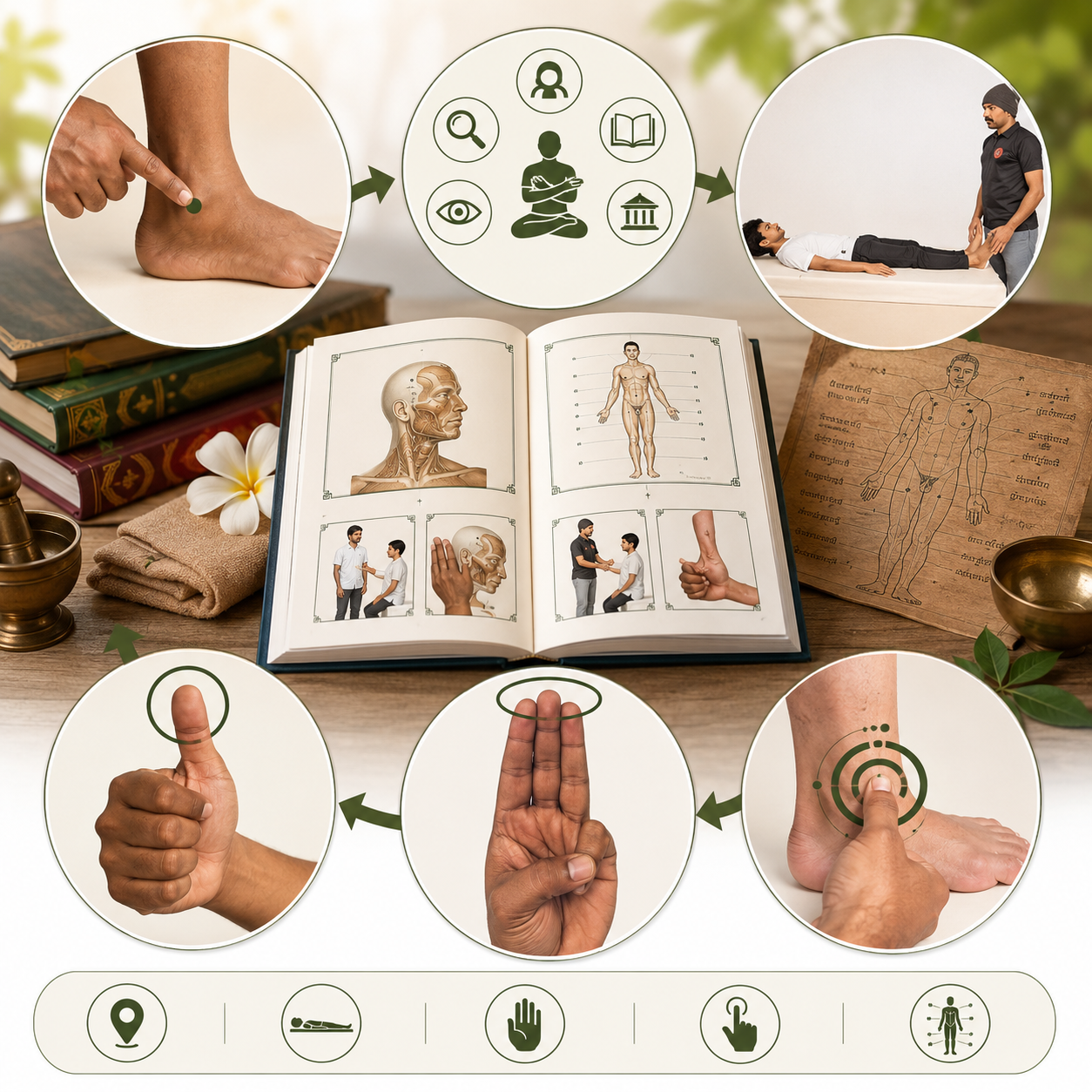
The Varmam Combo — Volumes 1 & 2
159+ Varmam locations and 48 Adangal methods — Adangal being the release techniques of the Siddha tradition — set out in plain language, with the classical source named beside each one. The reference behind everything on this blog.
Adangal: The Word For ‘Settled’
Adangal is the quietest of the four words, and in some ways the most interesting. It comes from the Tamil verb adangu, to settle or be contained. A modern training text describes it plainly: when the smoothly moving life-force, vaasi, is interrupted, the place where it is held back and stays settled is called Adangal.
A beautiful story in another book gives the idea an origin. Shiva and Parvati are walking in the forest when they find a hunter who has fallen from a tree and lies unconscious. At Parvati’s request, Shiva touches him with a golden staff and he wakes. In that moment Shiva explains to her that the body holds two kinds of places, Varmam and Adangal. It is a legend, not a historical record, and we offer it as the tradition tells it. But it shows how old the pairing is: one word for the place, and one for the settling.
The structure of Varma Peerangi echoes this. Its point sections are broken up by Adangal sections, each followed by a section on oils. Taken with what the other books say, the Adangal sections appear to deal with release methods, though a full reading of the verses would be needed to say so with certainty. In the Combo volumes we set the forty-eight Adangal methods out one by one.
Names That Describe A Place, A Shape Or An Effect
Most individual names follow one of three habits. Some describe a place: Sevikkuthi Kaalam, for instance, is named because the point lies close to the ear. Some record an effect the old teachers observed: Urakka Kaalam means “sleep time,” and Urumi Kaalam takes its name from a growling sound. A third group seems to describe a resemblance, such as Kannaadi Kaalam.
That last one shows how honest we have to be about origins. One commentary suggests Kannaadi (“spectacles”) is a descriptive name for the area on the nose where spectacles rest. Another book offers a completely different history: the point was first called Kannadai Varmam, a name tied to the eye, and over time people’s speech wore it into Kannaadi. Two books, two reasons, one name. Neither can be proved from the page alone.
The same books also show how names changed in copying. One modern editor notes that a text lists the point Thivalai (also spelled Thevalai) wrongly as Thelae Kaalam, and that Moothira Kaalam appears as Moorthi Kaalam in the manuscript. Because the manuscript’s wording cannot be changed, he records it as a variant reading and writes the commentary beside it. When a name looks strange, a scribe’s slip is sometimes the reason.
How To Read A Name In An Old Book
You do not need to read Tamil verse to get value from this. A small habit of reading carefully protects you from the most common mistake, which is to treat one list as the list. Point names differ between texts: the same location may carry two or three names, and the same name may be placed slightly differently by two authors. Of one placement of the point Kondai Kolli, an editor of Varma Sutram writes that it “differs from the text’s own view,” and that the place described is actually the Pidari Varmam. That is a scholar telling you, in print, that the books do not fully agree.
So treat every name as a pointer to a conversation between authors, not as an answer.
A Five-Step Practice For Reading Names
Saram First Reset™ — Your First Five Days Of Practice
Before the books, begin with the breath. Five short days of gentle, guided practice that give you the steadiness to study the tradition well.
Name Reading, One Point At A Time
Some people find the names click into place straight away; others feel lost for the first few weeks. Both are completely normal, and the pace does not matter.
Please look after yourself first. This is a reading practice, not a body practice. Do not press, strike or test any point on yourself or anyone else because a book names it. If you have pain, an injury or a health concern, see your doctor. Learn hands-on point work only from a qualified teacher.
Final Thoughts
Behind every strange name in these books is a person who looked closely at the body, noticed something, and found a word for it. Some of those words were handed on faithfully, some were worn down by speech, some were slipped by a tired scribe, and a few are argued over by scholars to this day. That is exactly what a living tradition looks like.
The honest way to honour it is to read slowly, to hold each explanation as one author’s view, and to keep asking questions of a teacher.
Bring Your Questions About The Names To A Live Call
Our Inner Circle community call runs every Thursday, 7.30–9.30 PM. It is free and it is live. Write to connect@vedhansri.com to join.
Join Thursday’s call — free Saram First Reset™ · ₹499
The Reset is five short days, self-paced. Most people come to the free call first.
5,500+ students trained · 28+ years of practice · 27+ master teachers learned from · 3 national recognitions
References & Further Reading
- Ancient Varmam manuscripts and verse texts, read in their printed editions: Varma Sutram (Tamil Virtual Academy digital library copy, catalogue no. TVA_BOK_0007282); Varma Peerangi, with its contents of 104 entries; Odivu Murivu Gnanam, verse text with prose meaning.
- Modern commentaries and training books that quote the manuscripts: Varma Sutram – 1 (edition with commentary); Varma Noolthogudhi – 1; Varma Pullikalin Irukkidam; Varmam 108; Varma Maruthuva Thodakka Payirchi Nool.
- Sushruta Samhita, Sharira Sthana, chapter 6, on the marma count.
- S. Ramesh Babu, Varmam – An Insight into the Ancient System of Healing: A Symposium on the Science of Life Force, Volume I (Revised Edition) and Volume II.
This is wellness education, not medical treatment. It does not replace advice from your doctor. Results vary from person to person.