
Charcoal, Salt And Neem: The Tooth Care India Was Told To Forget — Then Sold Back
In 1985, Colgate advertising warned Indians that salt and charcoal could damage their teeth. Twenty years later it was selling salt toothpaste — and then charcoal toothpaste. What changed was not the salt or the charcoal.
Think back to a village morning, before tubes and plastic brushes. Someone takes a pinch of fine black powder from a small tin. Charcoal, ground soft. Sometimes a little salt mixed in. They rub it on their gums with one finger — slowly, like a massage, not a scrub. In houses where meat was eaten, a neem twig came out afterwards to pick away what was stuck between the teeth.
Nobody called this a “method”. It was simply what the morning looked like.
Then, in 1985, Colgate’s advertising told India that this was a mistake. And by 2019, the same ingredients were back on the shop shelf — inside a tube, with a brand name on it.
This is the first article in a Vedhan Sri investigative series on Indian health knowledge that was sidelined or replaced. Every article asks the same five questions: what did the old sources actually say, what changed, who drove the change, what evidence connects the change to health today, and which parts are documented, plausible, disputed or simply unknown. We will be honest about all four.
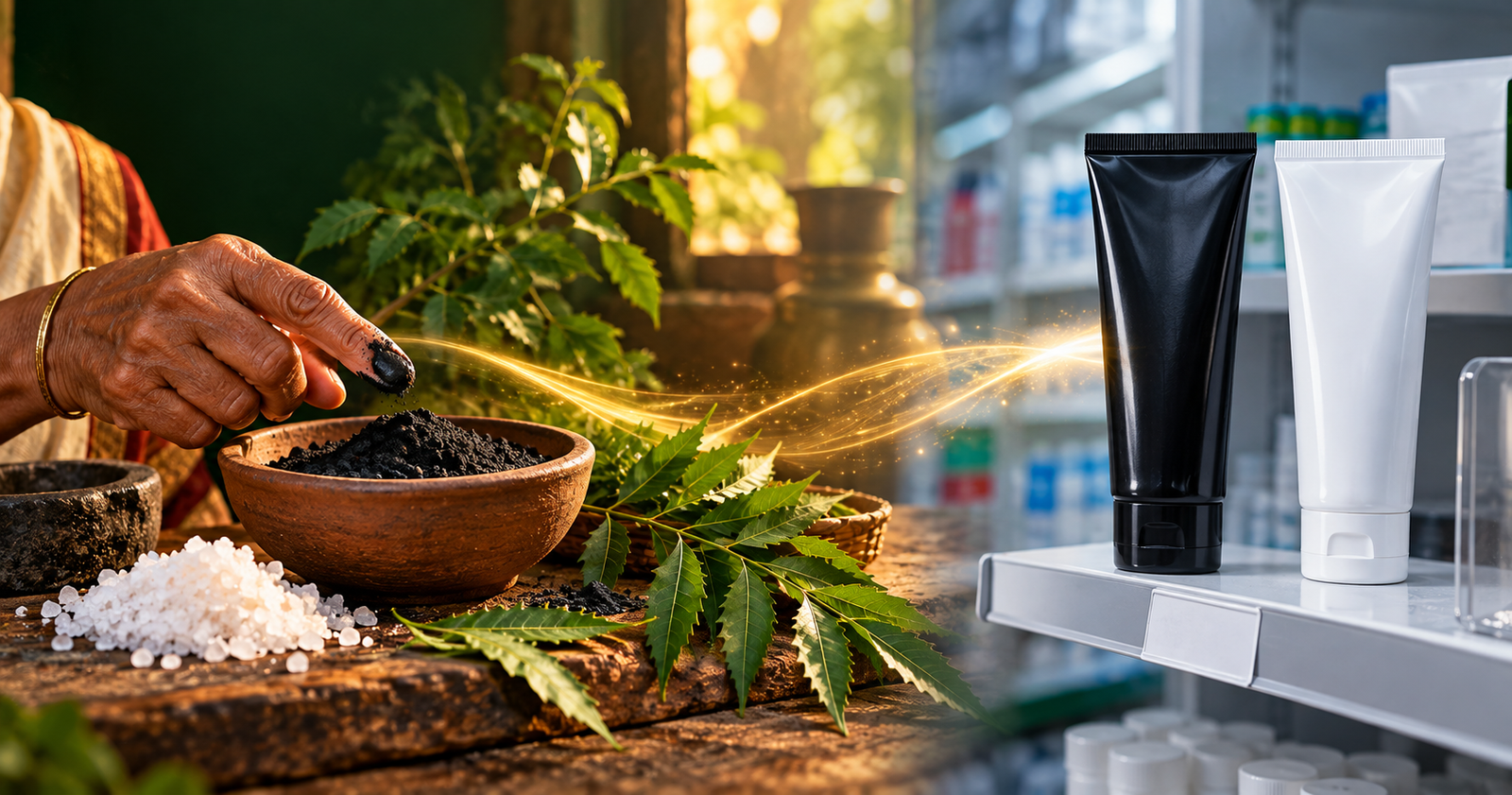
What The Old Texts Actually Describe
Cleaning the teeth sits at the very start of the daily routine — dinacharya, the traditional daily routine — in India’s classical health texts. The Charaka Samhita (Sutrasthana, chapter 5) places dantadhavana, tooth cleaning, among the first tasks of the morning, done with chewing twigs of astringent, pungent or bitter taste.
The Sushruta Samhita (Chikitsasthana, chapter 24) goes further. It names twigs by taste, with neem (nimba) among the bitter ones, and describes a tooth-cleaning paste that includes rock salt — saindhava lavana. Elsewhere, the Charaka Samhita ranks rock salt as the best of all salts.
So two of the three ingredients in our village morning — neem and salt — are written into texts that are well over fifteen hundred years old.
The third one needs honesty. We have not found charcoal named for teeth in these classical verses. Its record is different. It lives in household practice — and, as you will see, its clearest written proof comes from the very company that tried to end it.
What Families Actually Did
Written texts are one kind of source. Living practice, handed from grandparent to grandchild, is another. In Vedhan Sri’s family, the practice was passed down across generations in a very particular way:
- Fine powder, not grains. Charcoal and salt were crushed soft — nothing crystalline or gritty.
- Gums, not teeth. The powder went on the gums. The purpose, as it was taught, was strong gums — because strong gums hold the teeth.
- Massage, not brushing. A slow finger massage. No scrubbing motion at all.
- Neem for what got stuck. Families who ate meat also used neem twigs or tree bark to lift food from between the teeth and at the gum line. Neem was chosen deliberately, because it was trusted to keep any small scrape clean.
- Different villages, different mixes. Some regions used mainly charcoal, some mainly salt, some both together.
None of this was written in a manual. It did not need to be. It was taught by showing, and corrected by feel — if the powder was too coarse, your gums told you at once.

What our grandmothers did without a label, the market now sells with one. Learn to read the practice, not the packet.
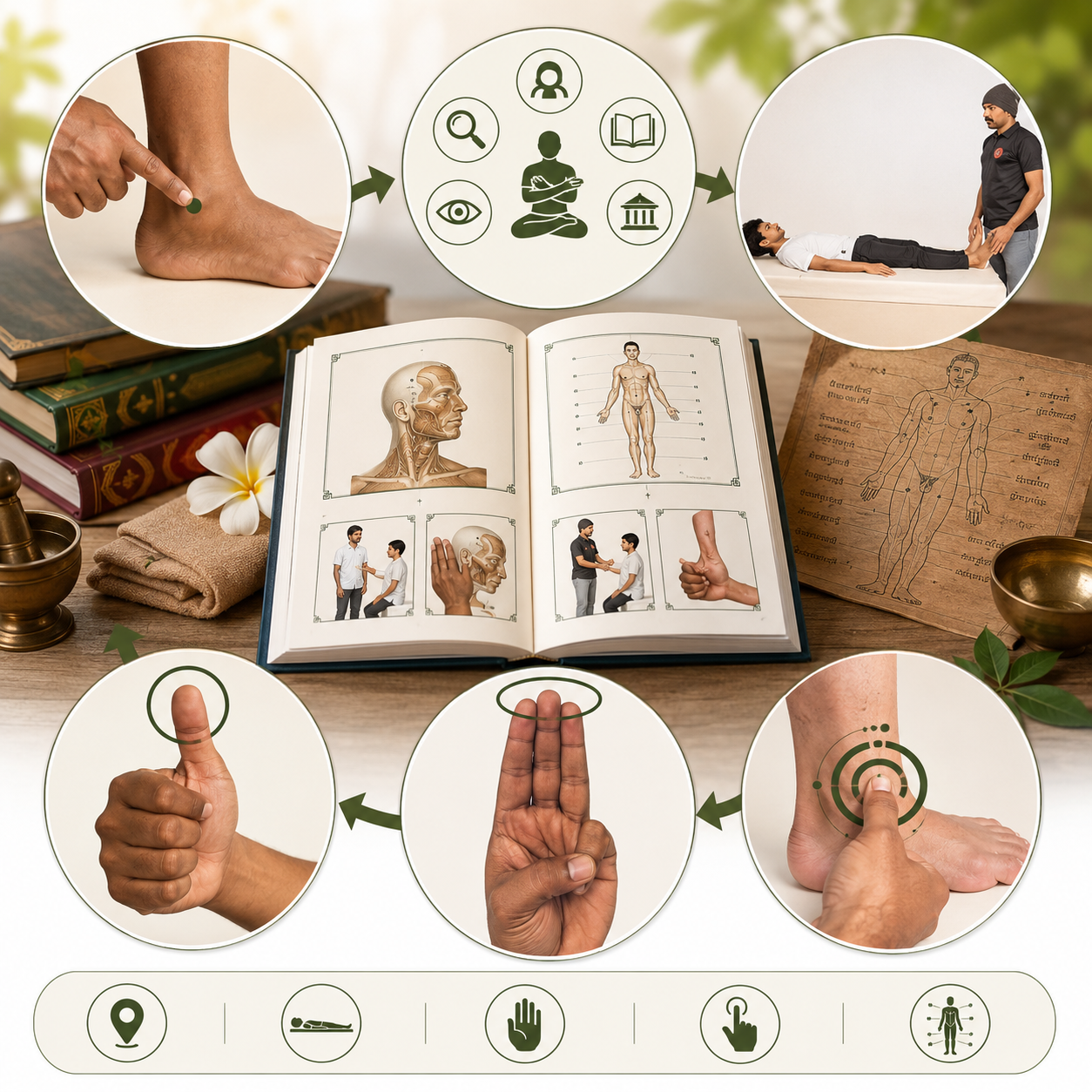
The Varmam Combo — Volumes 1 & 2
The Siddha tradition begins with how you live from dawn to dusk. Both volumes set out 159+ Varmam locations and 48 Adangal methods — Adangal being the release techniques of the Siddha tradition — in plain language, with the classical source named beside each one.
What Changed: A Timeline From Colgate’s Own Records
We did not want to build this story on rumours. So the timeline below is taken from Colgate-Palmolive India’s own published company history, and from dated press coverage. Read it slowly.
| Year | What happened | Source |
|---|---|---|
| 1937 | Colgate starts operations in India | Colgate India history |
| 1949 | Colgate toothpowder and toothbrushes launched | Colgate India history |
| 1985 | TV advert mocks charcoal for teeth; a Hindi print advert warns that “rough substances like salt and charcoal” can damage enamel | TV: afaqs! and OneYearMBA retrospectives. Print: widely circulated copy, date not independently traced |
| 2005 | Colgate Active Salt launched | Colgate / MediaBrief, 2024 |
| 2010 | “Kya aapke toothpaste mein namak hai?” campaign | ThePrint, 2022 |
| 2014 | Colgate Total Charcoal Deep Clean toothpaste launched | Colgate India history |
| 2016–17 | Vedshakti range, “powered with Ayurvedic ingredients” | Colgate India history |
| 2018 | Colgate Active Salt Neem introduced | Colgate India history |
| 2019 | Colgate Charcoal Clean — an all-black paste with bamboo charcoal; ZigZag Neem toothbrush | Colgate India history |
| 2020 | Super Flexi Salt toothbrush; Vedshakti Oil Pulling | Colgate India history |
Charcoal. Salt. Neem. Even oil pulling. Every item from the old morning routine came back — each one with a brand name, a price and a plastic pack.
The 1985 Adverts
The TV advert is remembered by name in Indian advertising writing. A bodybuilder asks for almonds and milk for his body — and charcoal, koyla, for his teeth. His sister-in-law laughs: “Badan ke liye doodh-badaam, aur daaton ke liye koyla?” A voice-over then warns that rough substances spoil the enamel, and the toothpowder is offered as the safe answer.
A Hindi print advertisement from the same campaign is sharper still. Its headline reads:
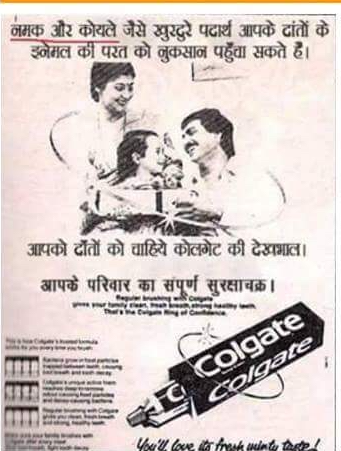
“नमक और कोयले जैसे खुरदुरे पदार्थ आपके दांतों के इनेमल की परत को नुकसान पहुँचा सकते हैं।”
In English: rough substances like salt and charcoal can damage the enamel layer of your teeth. Notice the first word. It is not only charcoal. It is salt — named first, and underlined.
In 2005, Colgate launched Active Salt. The ingredient its own advert had called a danger to enamel became the selling point of one of its best-known toothpastes.
The original TV broadcast copy is not publicly available. When asked about it years later, Colgate acknowledged the advert but said it could not share it. Our account of the TV version rests on two published retrospectives that record the dialogue.
Now look at what the warning did not say. It did not say which salt or which charcoal. It did not say how finely ground. It did not say whether it meant rubbing on the gums or scrubbing on the teeth. It did not show a study. It placed one idea in millions of minds: the kitchen is crude, the tube is modern.
And here is the quiet irony. Those adverts are the clearest written proof that salt and charcoal tooth care was common enough, in 1985, to be worth attacking.
Learn It In Person — Upcoming Live Workshops
Traditions survive when they are passed on hand to hand. Vedhan Sri runs small, hands-on workshops in JP Nagar, Bengaluru — next up is Supporting the Special Child (14–15 November 2026), with more through January 2027. Places are limited.
The Question Nobody Asked: Which Form?
Whenever tradition is questioned, the first demand is usually: prove it — which form, how much, how often? That is a fair question. But it has to be asked of everyone, not only of grandmothers.
| Who said it | What they said | Form specified? |
|---|---|---|
| The 1985 adverts | Salt and charcoal are rough substances that can damage enamel | No |
| Classical texts | Rock salt and neem belong in tooth care | Partly — twig types, a paste |
| Salt and charcoal toothpastes, 2005–2019 | Salt and charcoal are now a selling point | Not in the advertising |
| Family practice | Fine powder, on the gums, by massage, not brushing | Yes |
What about the science on the new products? In 2017, the Journal of the American Dental Association published a review of charcoal toothpastes. The reviewers found too little clinical and laboratory evidence to support either the safety or the benefit claims made for them. The same authors also noted recorded cases where charcoal particles lodged in gum tissue and left a bluish line.
That is worth holding in mind — for tins and tubes alike. Nobody has studied charcoal in the specific way it was used in these households: finely powdered and massaged into the gums. That study simply does not exist. It was never funded, because a practice that costs nothing has no sponsor.
One more thing the 1985 adverts never examined was the brush itself. Dentists today have a name — toothbrush abrasion — for wear caused by hard bristles and heavy scrubbing. The old practice, which did not scrub at all, was never compared against it.
Saram First Reset™ — Your First Five Days Of Practice
This article is about noticing which daily routines were quietly replaced. The First Reset is where you begin rebuilding your own — five short days of Saram, the Siddha breath practice, with no equipment needed.
What If The Tradition Had Been Studied Instead Of Mocked?
Imagine a different 1985. Instead of an advert, a study. Researchers go to the villages, record exactly how the powder was prepared, how it was applied, and follow the people who used it. Whatever they found — good, bad or mixed — we would know today. Families would have been given evidence instead of embarrassment.
That did not happen. What happened instead follows a pattern this series will keep meeting: a practice is made to look backward, it is replaced, and later the same ingredient returns inside a product. Next in this series we will follow that pattern through cannabis medicine, country chicken, and millets — the grain India sidelined for decades before the world celebrated 2023 as the International Year of Millets. For how Siddha knowledge itself was carried down the generations, read our history of Varmam.
Where the evidence stands
| Status | Claim |
|---|---|
| Documented | Neem twigs and rock salt appear in classical tooth-care passages (Charaka, Sushruta) |
| Documented | Colgate’s own timeline: toothpowder 1949, Active Salt 2005, charcoal paste 2014, salt-neem 2018, bamboo charcoal 2019 |
| Documented | Colgate advertising warned that salt and charcoal harm enamel — the TV advert via published retrospectives; the print advert as circulated, its 1985 date not independently traced |
| Plausible | Salt-and-charcoal gum care was widespread before tubes arrived — the adverts only make sense if it was |
| Disputed | Whether charcoal in any form is safe or useful for teeth — modern reviewers say the evidence is not there |
| Unknown | How the traditional form — fine powder, massaged on gums — compares with brushing. It has never been studied |
A Five-Step Family Record
This practice uses no powder and no product. It is about keeping a memory before it disappears — the oldest way Indian health knowledge was ever preserved.
Ask The Elders
Some elders will remember every detail; some will remember nothing at all — both are normal, and both are part of the record.
Please look after yourself first. This article describes historical and household practice as history. It is not a recommendation to put charcoal, salt or anything else on your teeth or gums. If your gums bleed, hurt or swell, see a dentist, and speak to your dentist before changing how you care for your teeth.
Final Thoughts
This is not a story about charcoal being magic, or toothpaste being evil. It is a story about who gets asked for proof. For forty years, the burden fell only on the household practice. The adverts that attacked it, and the products that later sold it back, were never asked the same question.
The fair position is the simple one: ask everyone for the same evidence. Until that evidence exists, the old practice deserves to be remembered accurately — as history, carefully described — and not as a joke from a 1985 advert.
Frequently Asked Questions
Did people in India really clean their teeth with salt and charcoal?
Household practice and the 1985 adverts both say yes. The warning only makes sense if salt and charcoal tooth care was common enough to compete with toothpowder. Rock salt and neem twigs are also named in classical Sanskrit texts; charcoal is not, as far as we have found.
Is charcoal toothpaste proven to be better or safer?
No. A 2017 review in the Journal of the American Dental Association found too little evidence to support the safety or benefit claims made for charcoal toothpastes.
Should I start using charcoal or salt on my gums?
This article describes history, not a treatment. Nobody has studied the traditional method properly, so there is no evidence either way. Please speak to your dentist before changing how you care for your teeth and gums.
Bring your family’s story to a live call
Our Inner Circle community call runs every Thursday, 7.30–9.30 PM. It is free and it is live. Write to connect@vedhansri.com to join.
Join Thursday’s call — free Saram First Reset™ · ₹499
The Reset is five short days, self-paced. Most people come to the free call first.
5,500+ students trained · 28+ years of practice · 27+ master teachers learned from · 3 national recognitions
References & Further Reading
- Charaka Samhita, Sutrasthana chapter 5 — daily routine and tooth cleaning (dantadhavana).
- Sushruta Samhita, Chikitsasthana chapter 24 — tooth-cleaning twigs by taste, and a cleaning paste with rock salt (saindhava).
- Colgate-Palmolive (India) Ltd, company history — colgateinvestors.co.in/history — 1937, 1949, 2014, 2016–17, 2018, 2019 and 2020 entries.
- MediaBrief, April 2024 — Colgate Active Salt available “since 2005” — mediabrief.com.
- ThePrint, August 2022 — the 2010 “namak hai” campaign — theprint.in.
- afaqs! (September 2016) and OneYearMBA (September 2015) — retrospectives recording the 1985 TV toothpowder advert and its dialogue. The original broadcast copy is not publicly available.
- Colgate Hindi print advertisement (“namak aur koyle jaise khurdure padarth…”), circulated online as 1985 since at least February 2019; original publication not traced.
- Brooks JK, Bashirelahi N, Reynolds MA. “Charcoal and charcoal-based dentifrices: A literature review.” Journal of the American Dental Association, 2017;148(9):661–670 — DOI: 10.1016/j.adaj.2017.05.001; and the same authors’ follow-up letter, JADA 2017;148:785.
- Product names are used only to identify products in a historical account; brand names belong to their owners.
- S. Ramesh Babu, Varmam – An Insight into the Ancient System of Healing: A Symposium on the Science of Life Force, Volume I (Revised Edition) and Volume II.
This is wellness education, not medical treatment. It does not replace advice from your doctor. Results vary from person to person.
Tell us in the comments below. Which one did your grandparents swear by — the neem twig, the pinch of salt, the charcoal, or something else — and what do you still remember about the morning they handed it to you?