
Where Does Varmam Come From? Tracing The Body’s Vital Points From The Vedas To Kanyakumari
One line in the world’s oldest scripture already holds both words — marma and varma. Here is the long, honest trail of how a map of the body’s vital points travelled from battlefields to healing hands, and what the record can and cannot tell us.
People who come to Varmam — pressure points on the body, in the Siddha tradition — usually ask two questions. The first is practical: where are the points, and what do I do with them? The second comes a little later, once the practice has started to feel real: how old is this, really, and who worked it out?
This post is about the second question. It is a history, told plainly, with the sources named. Where the record is strong, we say so. Where it is thin, or where a popular story has run ahead of the evidence, we say that too. A tradition this old does not need exaggeration to be remarkable.
One Line Of Scripture Already Holds Both Words
The oldest written trace sits in the Rig Veda, a collection of hymns more than three thousand years old. In a hymn addressed to a warrior’s weapons and armour (Rig Veda 6.75.18), the poet says, roughly:
marmāṇi te varmaṇā chādayāmi“I cover your vital points with armour.”
Look at the two key words. Marman means a vital spot — a place where an injury can take a life. Varman means armour, the thing that protects it. The Sanskrit and Tamil traditions went on to use related words for the same body of knowledge: Marma in Sanskrit, Marmam in Malayalam, Varmam in Tamil.
Whether the Tamil word descends from this Sanskrit line, or the two grew side by side from something older, is a question scholars still argue about. We will not pretend to settle it here. What the verse proves is simpler and more striking: the idea that the body has specific, vulnerable places worth protecting was already old when it was written down.
An Injury Map Before It Became A Healing Map
Almost every early reference is about war. The later Vedic hymns and the epics speak of vital points as places to strike and places to shield — on soldiers, and even on horses and elephants. This matters, because it tells you how the knowledge was first gathered. People learned where the body is fragile by watching what happened when it was hit.
The turn toward healing is clearest in the Sushruta Samhita, the classical Sanskrit text of surgery, usually dated to around two thousand years ago. Its sixth chapter on the body counts 107 marma, sorts them by the tissue that meets there — muscle, vessel, ligament, bone, joint — and sorts them again by what happens when they are injured, from instant danger to lasting pain. Sushruta calls this knowledge half of the entire science of surgery. A surgeon had to know where not to cut.
That is the pattern this whole history keeps repeating: the map of harm came first, and the map of help was drawn from it. The same place that a strike can damage is the place where careful, gentle pressure can be felt most.
The Southern Branch: Siddha, Agastya And The Verse Manuscripts
In the Tamil country the same knowledge took a different shape. It lives inside Siddha — the classical Tamil healing tradition — as one of its three specialities, alongside Yogam and Kayakarpam. And it is kept not in one standard textbook but in verse, on palm leaf, passed from teacher to student.
The tradition’s own account of its origin is a lineage story. Shiva taught the knowledge to Parvati; it passed to Murugan; and Murugan, disguised as an old man, gave the 108 Varmam to the sage Agastya, who set them down in verse for his students. Many Varmam texts carry Agastya’s name.
Here honesty helps more than reverence. Tamil literature knows many figures called Agastya or Agathiyar across different centuries, and the original authors of these verses are not known. What survives are copies — palm-leaf manuscripts written out by students and families, most of them undated. The Siddha scholar N. Shunmugom estimated the Varmam literature at more than 30,000 verses across roughly 110 titles, almost all in Tamil, a few in Tamil written in Malayalam script.
These texts count 108 Varmam where Sushruta counts 107. One well-known text, Varma Beerangi, divides them by region: 25 from head to neck, 45 from neck to navel, 9 from navel to the base of the trunk, 14 in the arms and 15 in the legs. And the point names are not standardised — the same place can carry different names in different books. That is exactly what you would expect from knowledge that stayed in many separate teaching families rather than being collected into one official canon.
There is one more difference worth knowing. Sushruta defines a marma as a place where tissues meet. Siddha teachers describe Varmam as the energy — the moving breath, Vaasi — and the place as only where that energy can be met. Marma teaching leads with anatomy. Varmam teaching leads with breath.
The warrior learned where the body breaks. The healer learned to touch the same place gently.
One Art, Many Names
If you read about this subject for long, the names multiply. Most of them describe the same body of knowledge from a different angle — the language it is taught in, or the side of it being used.
| Name | Where you will hear it | What it points to |
|---|---|---|
| Varmam · Varma Kalai | Tamil Nadu | The whole art of vital points, in Siddha |
| Marmam · Marma Chikitsa | Kerala, in Malayalam | The same points, especially inside Kalarippayattu |
| Marma · Marma Vidya | Sanskrit, Ayurveda | The 107 points of Sushruta and later texts |
| Vaidhiya Murai | Siddha healers | The healing side — easing and restoring |
| Varma Adi · Adimurai | Southern martial schools | The striking side — the fighting application |
Siddha texts also use a family of words for the life-force that Varmam is about. One text, Vaakata Nithanam, is reported to list names such as Vaasi, Kaalam, Uyir, Pranan, Kalai and Saram among them. You will notice the last one. Saram — the flow of breath — is the name we chose for our own teaching, because it keeps the attention where the Siddha tradition put it: on the breath that moves through the points, not only on the points themselves.
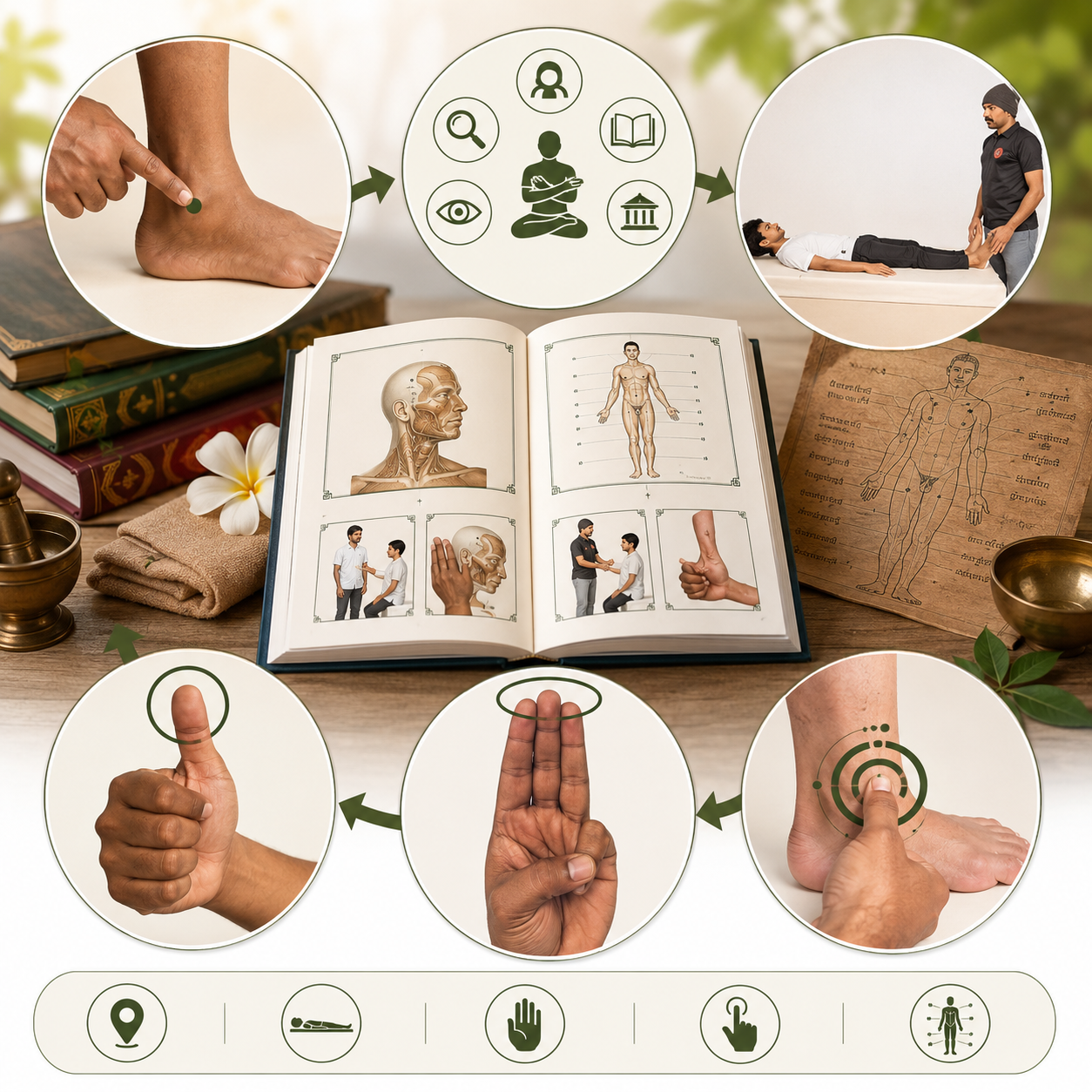
The Varmam Combo — Volumes 1 & 2
159+ Varmam locations and 48 Adangal methods — Adangal being the release techniques of the Siddha tradition — set out in plain language, with the classical source named beside each one. The reference behind everything on this blog.
Kanyakumari And Travancore: Where The Two Streams Meet
Geography explains a lot of this story. The southern tip of India — today’s Kanyakumari district and the old kingdom of Travancore — is where the Tamil and Malayalam worlds overlap. It is also where the vital-points tradition is still practised most intensively.
In Kerala, the points are taught inside Kalarippayattu, the Kerala martial art, where students learn both how to strike them and how to treat the injuries that training causes. The southern style of Kalarippayattu, closest to Tamil Nadu, carries the strongest Tamil influence and credits its lineage to Agastya. In the old Travancore region it is often called Varma Ati. The northern Kerala style is more distinct.
So the picture is not two rival systems. It is one very old observation — the body has places where force and care both concentrate — carried in two languages, recorded in two literary traditions, and practised by martial teachers and healers who often knew each other’s work.
Learn It In Person — Upcoming Live Workshops
History is best understood with your own hands. Vedhan Sri runs small, hands-on workshops in JP Nagar, Bengaluru — next up is Supporting the Special Child (14–15 November 2026), with more through January 2027. Places are limited.
What The Colonial Record Shows — And What It Doesn’t
We wanted to know whether the Portuguese, Dutch, French or British, who spent centuries on this coast, ever wrote Varmam down. The answer, as far as our search could reach, is candid and a little surprising.
Europeans certainly studied South Indian healing. The best-known example is the Hortus Malabaricus, twelve volumes published in Amsterdam between 1678 and 1693 under the Dutch governor Hendrik van Rheede, with the Kerala physician Itty Achuden among its expert sources. It is a monumental record of Kerala’s medicinal plants. But it describes plants, not vital points.
We found no confirmed European description of Varmam or Marmam from the Portuguese, Dutch, French or British periods. That does not mean none exists — large archives in Chennai and in Europe are still being catalogued — only that we could not verify one, and we would rather tell you that than invent a quotation. Instead, the first serious modern comparison came from within India: a Comparative Study of the Marmas by P.V. Krishna Rao, published at the Government Indian Medical School in Madras in 1941. Serious academic study in English followed from the 1990s onward.
There is a likely reason for the silence. Varmam was guarded knowledge. Teachers encoded point locations in verse precisely so that they could not be picked up and misused by outsiders. A system built to be kept close is not one that travellers get to write down.
Saram First Reset™ — Your First Five Days Of Practice
History tells you where this came from. Practice tells you what it feels like. Five short days: your first Saram lesson, breath observation, practices for breathing ease and digestive comfort, and family care. No flexibility, equipment or floor space needed.
What This History Means For Your Own Practice
A long history is not proof that something works for you. The classical texts are records of tradition and documented practice, not clinical trials, and we will never present them as anything else. But the history does tell you something useful about how to begin.
Both traditions started with protection. Both learned that these places respond to force, so both teach light, attentive touch rather than hard pressing. And the Siddha branch starts even earlier than touch — with the breath. If you want to begin where the tradition begins, begin there.
A two-minute breath observation
That is all. No point to press, nothing to force. Some people notice a quieter mind within a minute or two; some notice which side of the nose is more open and are surprised it changes through the day; and some people notice nothing at all the first few times. All three are normal.
Please look after yourself first. If you are dizzy, breathless, in pain, or managing a heart, lung or neurological condition, speak to your doctor before any new practice, and stop if anything feels wrong. This practice does not replace medical care.
If you want to know what the points themselves are and how the 108 are organised, our earlier post What Is Varmam? The Siddha Science Of Pressure Points is the natural next read.
Final Thoughts
Trace the vital points back as far as the record goes and you reach a single line of scripture about armour. Follow them forward and you pass through the surgeon’s manual, the Tamil palm-leaf verse, the Kalari of Travancore, a 1941 study in Madras, and today’s university libraries. The names change along the way. The observation underneath does not: the body has places where care, like force, is felt most.
That is the inheritance. What you do with it starts, as it always has, with the breath.
Bring your questions about the tradition to a live call
Our Inner Circle community call runs every Thursday, 7.30–9.30 PM. It is free and it is live, and questions about where this knowledge comes from are always welcome. Write to connect@vedhansri.com to join.
Join Thursday’s call — free Saram First Reset™ · ₹499
The Reset is five short days, self-paced. Most people come to the free call first.
5,500+ students trained · 28+ years of practice · 27+ master teachers learned from · 3 national recognitions
References & Further Reading
- Rig Veda 6.75.18 — the verse joining marma (vital spot) and varman (armour).
- Sushruta Samhita, Sharira Sthana, chapter 6 — the count of 107 marma (6/3), their definition as a meeting of tissues (6/15), and their place as half of surgery (6/35).
- Varma Beerangi and Varma Odivu Murivu Sara Soothiram 1200 — Tamil Siddha verse texts giving the 108 Varmam and their regional division.
- Shunmugom, N., “Tamils’ Varma Therapy for the World Medical Field”, 4th National Siddha Doctors Conference, Chennai, 2006 — on the size of the Varmam literature and Varmam as energy rather than place.
- Krishna Rao, P.V., Comparative Study of the Marmas, Government Indian Medical School, Madras, 1941.
- van Rheede, H., et al., Hortus Malabaricus, 12 volumes, Amsterdam, 1678–1693 — the Dutch record of Kerala’s medicinal plants.
- Zarrilli, P.B., “To Heal and/or To Harm: The Vital Spots (Marmmam/Varmam) in Two South Indian Martial Traditions”, Journal of Asian Martial Arts 1(1), 1992; and When the Body Becomes All Eyes, Oxford University Press, 1998.
- Sieler, R., Lethal Spots, Vital Secrets: Medicine and Martial Arts in South India, Oxford University Press, 2015.
- S. Ramesh Babu, Varmam – An Insight into the Ancient System of Healing: A Symposium on the Science of Life Force, Volume I (Revised Edition) and Volume II.
This is wellness education, not medical treatment. It does not replace advice from your doctor. Results vary from person to person.