
Why The Knot Comes Back: The Question Massage Never Asks
You paid for the massage. It was wonderful. By Wednesday the knot was back in exactly the same place, and the neck and shoulder tension relief you paid for had quietly worn off.
That is not a failed massage. That is a message.
Something put the knot there. The massage removed the knot. It did not remove the something. So the something, being diligent, put it back.
Most of us answer this by looking for a better massage — deeper thumbs, a longer session, someone who really gets in there. That is a reasonable thing to try, and it usually buys a few more days of neck and shoulder tension relief.
This post is about the other question — the one that makes neck and shoulder tension relief last. Not how do I get rid of this, but what is it for.
A Knot Is A Job, Not A Fault
Your head is heavy and it sits at the top of a column. Every hour that it drifts forward — towards a screen, a steering wheel, a phone in your lap — something at the back of your neck and the top of your shoulders has to hold it there.
Holding is work. Sustained holding is sustained work. And muscle that has been asked to hold for nine hours does not politely return to neutral at six in the evening; it stays part-contracted, because as far as it can tell the job is still on.
That is the ridge you can feel under your fingers right now, if you reach across. It is not damaged tissue. It is tissue that has not been told it can stop.
Which is why relief that comes from outside tends not to hold. You can release the muscle. You have not yet changed what it thinks its job is.
The Thing Siddha Says That Almost Nobody Has Heard
Here is where the Tamil tradition says something genuinely unusual, and it is worth slowing down for.
In Ayurveda, a marma is defined as a place — the confluence of muscle, vein, ligament, bone and joint. A location on the body.
In Siddha, varmam is not the place. Dr N. Shunmugom, addressing the 4th National Siddha Doctors Conference in Chennai in 2006, put it about as plainly as it can be put: the location is the varma idam — the varmam place. The place is not the varmam. The energy is.
The old Tamil line is Vaasi thattum thaanam varma idam — where the breath strikes is a varmam place. Notice the grammar. Breath first. Place second. The place is named after what arrives there.
Two traditions, the same body, a different noun. One names a spot. The other names something that moves, and treats the spot as merely where it happens to rest.
If you accept that framing even provisionally, a lot follows — including why pressing harder has never worked as well as you hoped.
Three Points, And None Of Them Is Where Your Hand Goes
A 2022 review from the National Institute of Siddha in Chennai went through the classical Varmam texts and collected the points documented in the upper limb — thirty-three of them, with the count differing from text to text. Three sit at the shoulder.
Asaivu VarmamAt the back, near the acromial angle of the shoulder blade — the bony corner you can find at the top-outer edge of your shoulder
Sulluku VarmamAt the medial posterior of the shoulder joint — behind the joint and towards the spine
Puja VarmamOver the anterior aspect of the glenohumeral joint — the front of the ball-and-socket itself
The texts do not fully agree with each other, and it would be dishonest to pretend otherwise. Of the classical works the review compared, Puja Varmam is named in five, Sulluku in three, Asaivu in two. Varmam came down through teaching lineages rather than a single canon, so the same location often carries different names in different books.
But look at what they do agree on. Front of the joint. Behind the joint. The bony corner above and behind it. The tradition’s attention is on the hinge — and yours is on the muscle that is straining because of how the hinge is being held.
Which is the same lesson as yesterday, in a different key
Yesterday’s post was about the lower back: the ache arrives at the end of a chain that starts at your hip. This is the same shape of idea, one storey up. The place that hurts is rarely the place that is asking.
The place is not the varmam. Which is why the thumb is not the tool.
Why Pressing Harder Is The Wrong Lever
If the point were the varmam, force would be the obvious tool. More pressure, more effect. Find the sorest spot, lean on it, win.
But if the point is only where something rests, then leaning on it is rearranging the furniture in a room whose window is shut.
Which is why Varmam is never taught on its own. It sits beside Vaasi — breath work — and the three specialities of Siddha are always listed together: Varmam, Yogam and Kayakarpam. Touch is one half of a pair. In the classical framing, breath is the thing that actually moves; touch only tells it where to go.
So the practice below asks for almost no pressure at all. If you have been trained to believe that useful means painful, it will feel like nothing is happening. Do it anyway, for a fortnight, and then judge.
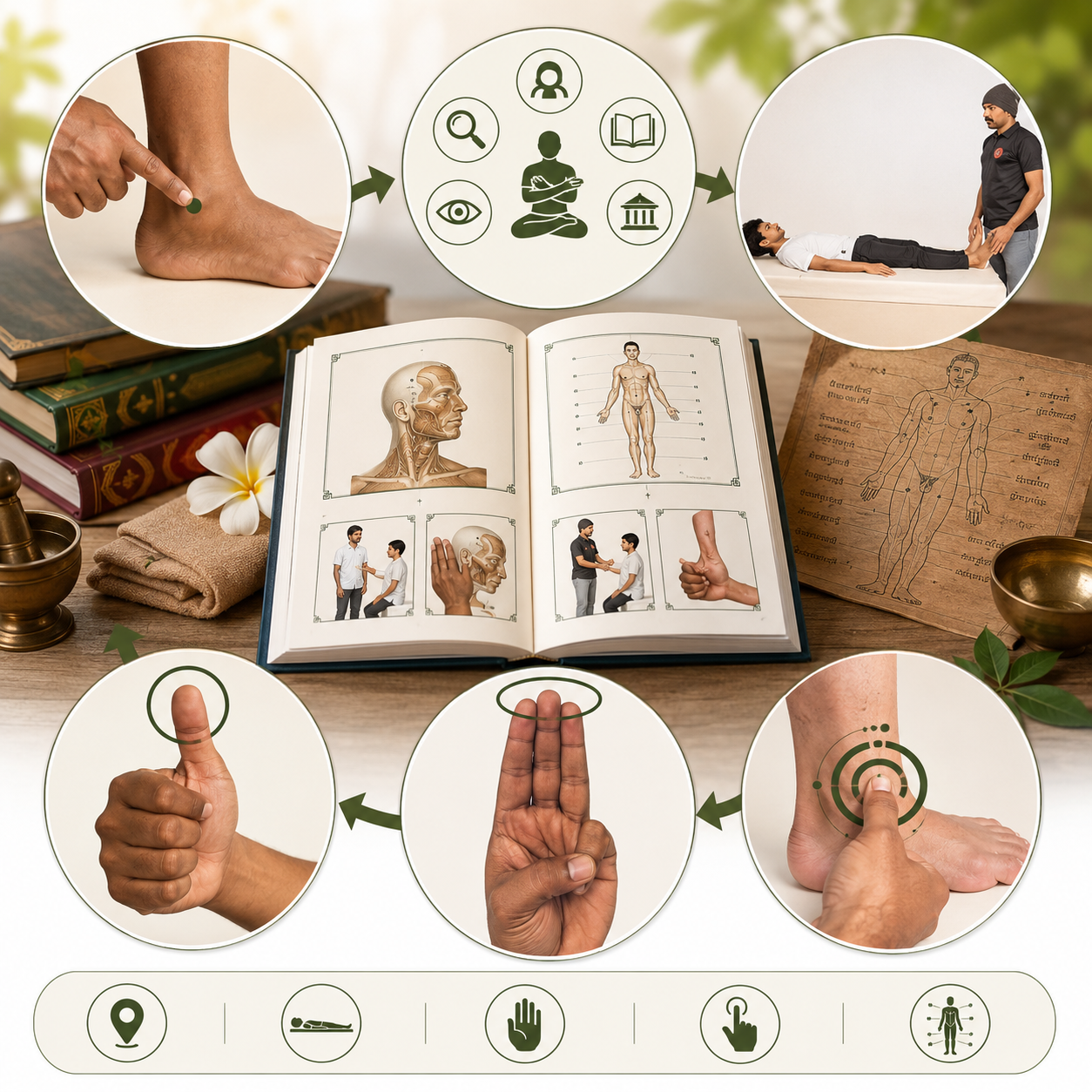
The Varmam Combo — Volumes 1 & 2
159+ Varmam locations and 48 Adangal methods — Adangal being the release techniques of the Siddha tradition — written out in plain language, with the classical source named beside each one. The reference book behind everything on this blog.
The Practice: Two Fingers And Five Breaths
Sitting or standing, either is fine. It takes about ninety seconds a side, and it is the simplest neck and shoulder tension relief practice I teach.
- Reach across with the opposite hand and find the sore ridge between your neck and the point of your shoulder. You will not have to hunt for it.
- Rest two fingers there. The weight of the hand is the whole pressure. You are not pressing, kneading or digging. If you can see the skin blanch, that is already too much.
- Let that shoulder drop away from your ear. Most people are carrying it half an inch higher than they realise, all day.
- Five slow breaths. In through the nose. Out through the mouth, and make the out-breath longer than the in-breath. Keep your attention under your fingers, not on the breath itself.
- Take the hand away while it still feels pleasant. Then do the other side.
If it hurts, you are doing a different exercise. Discomfort means you have gone back to pressure, which is the habit this practice exists to interrupt. Lighten until it is almost boring. Boring is the correct dose.
What To Expect, Honestly
Some people notice the shoulder drops more easily by the end of the first week. Some notice nothing at all for a fortnight and then find they have stopped shrugging while they type. Some notice nothing, full stop — and that is worth knowing before you start, rather than after.
What is more reliably useful is the noticing itself. Once you have spent ten days putting two fingers on that ridge, you start catching the shoulder on its way up — mid-email, mid-traffic, mid-difficult-conversation. That is the actual skill. The knot was always a messenger; you are simply learning to read the post before it piles up.
When this post is not about your situation
If your neck or shoulder pain followed a fall, a crash or any blow to the head or neck; if it travels down your arm; if it comes with numbness, tingling, pins and needles or weakness in the hand; if you have dizziness, visual changes or headaches alongside it; or if you have pain in the jaw, chest or left arm — stop reading and see a doctor. Some of those are urgent. Traditional practices sit alongside proper medical care. They never sit in front of it.
Final Thoughts On Neck And Shoulder Tension Relief
A knot that comes back is not evidence that you are broken, or that the massage was wasted. It is evidence that something is still asking, and that removing the symptom did not answer the question.
The tradition’s answer is not a harder thumb. It is a lighter hand and a longer breath, put somewhere near the joint, often enough that the muscle eventually believes the job is over.
Reach across. Let the shoulder down. It has been up since about nine this morning.
Bring the shoulder to a live call
Our Inner Circle community call runs every Thursday, 7.30–9.30 PM. It is free and it is live, and shoulders are the single most common thing people bring. Describing yours out loud, to someone who can ask you three follow-up questions, gets you further than any article can. Write to connect@vedhansri.com to join.
Join Thursday’s call — free Saram First Reset™ · ₹499
The Reset is five short days, self-paced. Most people come to the free call first.
5,500+ students trained · 28+ years of practice · 27+ master teachers learned from · 3 national recognitions
Sources for this article: Krishnapriya D., Mahadevan M.V. & Muthukumar N.J., “Documentation of Varmam Points Located in the Upper Limb by Analysing Various Siddha Varmam Literature”, IJCRT Vol 10 Issue 11, November 2022, ISSN 2320-2882, National Institute of Siddha, Chennai — the thirty-three upper-limb points and the documented locations of Asaivu, Sulluku and Puja Varmam. Shunmugom N., “Tamils’ Varma Therapy for the World Medical Field”, 4th National Siddha Doctors Conference, Chennai, 25 November 2006 — the varma idam definition. Sushruta Samhita, Sharira Sthana ch. 6 — the Ayurvedic definition of marma as a confluence. Sri Ramesh Babu (Vedhan Sri) is Founder Trustee of Varma Kalpa Rejuvenation Center.