
The Lower Back Doesn’t Start The Problem — It Finishes It
Nine in the morning: nothing. Six in the evening: a low, dull ache that makes you shift in your chair and stand up more carefully than you used to.
Same back. Same person. Nine hours in between.
Whatever is happening, it is not structural — structures do not keep office hours. Something accumulates across the day and then reports itself, at roughly the same time, most days.
This post is about where that accumulation actually starts, why the oldest Indian map of the body puts its markers somewhere other than the sore spot, and a two-minute standing reset you can do at your desk without anyone noticing.
Eight Hours In A Chair Is Not Rest
We talk about sitting as though it were the absence of activity. It is not. Sitting is a sustained position, and sustaining anything for eight hours is work. The difference is that the work is being done by tissues that never send you a bill until the end of the day.
When you sit, the crease at the front of your hip folds and stays folded. The muscles across the front of the hip shorten and stay short. The pelvis tips slightly backward and stays tipped.
None of those are injuries. All of them are positions held far longer than they were designed to be held.
And then you stand up — and your lower back, which spent the day as the one part of the system compensating for all of it, is the part that speaks.
Where Ayurveda Puts Its Attention
Marma — pressure points in the Ayurvedic tradition — is a map of 107 specific locations, set out in Sushruta’s Sharira Sthana. Sushruta defines a marma as the confluence of muscle, vein, ligament, bone and joint: the places where five different kinds of tissue meet and have to negotiate.
What is interesting for our purposes is not the definition. It is where the map is crowded and where it is sparse.
The back carries fourteen marma, arranged in seven pairs. And several of them sit nowhere near the middle of the back at all. They sit around the pelvis and hip:
| Marma | Where it sits |
|---|---|
| Nitamba | The upper edge of the pelvis, either side |
| Kukundara | Where the base of the spine meets the pelvis |
| Katikataruna | On the line between the sitting bone and the top of the thigh bone |
Read that last one again, because it is the whole point of this post. The sitting bone. A marma named on the line running from the part of you that bears your weight for eight hours a day.
The classical map does not crowd the spot where you feel the ache. It crowds the region just upstream of it.
That is not a claim about mechanism, and it should not be dressed up as one. It is an observation about where a two-thousand-year-old map of the body chose to place its markers — and the placement is suggestive.
A detail worth pausing on
The classical texts measure these points in finger-widths from a bony landmark. Not in centimetres. Not from a printed diagram.
Ani sits three fingers above the knee. Indravasti sits four fingers below the elbow crease. Urvi sits four fingers above Ani.
Whose fingers? Yours.
The map calibrates itself to the body it is being applied to. A tall person and a short person, following the same instruction, arrive at proportionally correct locations on their own frames.
That is a rather elegant piece of design for a system with no measuring instruments — and it tells you something about the intent behind it. This was never meant to be a chart on a wall. It was meant to be used by hand, on a specific person, by someone standing in front of them.

The place that hurts is usually the last link in the chain, not the first.
So The Useful Question Changes
It stops being how do I get rid of this ache and becomes what is feeding it, and can I interrupt that instead.
Which is good news, because the ache is hard to argue with and the feeding is easy to interrupt. It costs two minutes, a few times a day.
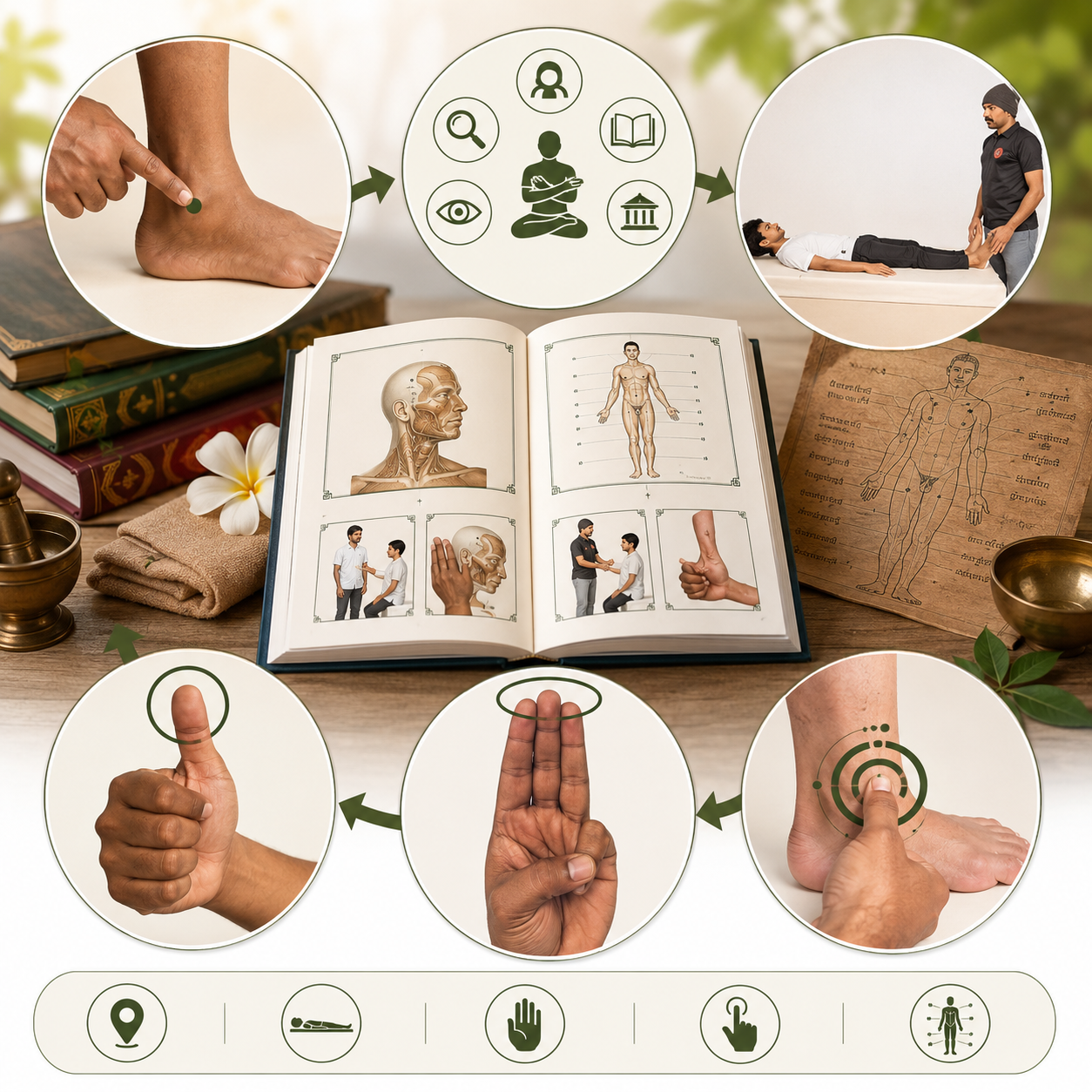
The Varmam Combo — Volumes 1 & 2
159+ Varmam locations and 48 Adangal methods — Adangal being the release techniques of the Siddha tradition — written out in plain language with the classical sources named. The reference book behind everything on this blog.
The Two-Minute Standing Reset
Do this standing at your desk, roughly every two hours. It takes less time than deciding whether to do it.
- Stand with feet hip-width apart. Place your hands on the front of your hips, right in the crease that folds when you sit.
- Push the hips gently forward, standing tall, until you feel a mild opening at the front of the hip. Not a stretch you have to brace for — a mild one. Hold for three slow breaths.
- Hands on the waist. Lean slowly to the left, breathe out, come back. Then the right. Three times each side.
- Let the arms hang. Roll the shoulders backward five times, slowly.
- One long breath out through the mouth. Then sit back down.
Frequency beats quality here. Four honest two-minute breaks will do more than one careful twenty-minute session at the end of the day — because you are trying to interrupt an accumulation, not clear one that has already finished building.
Give It A Fortnight
What some people notice first is not the ache itself but its arrival time — it turns up later in the day than it used to. Results vary, and some people notice no change at all; that is worth knowing before you start.
What you are really building is the same thing Day 1 was about: the habit of reading the signal instead of only reacting to it. Your back has been filing the same report at roughly the same hour for a long time.
When this post is not about your situation
If your back pain arrived suddenly, is severe, followed a fall, travels down a leg, or comes with numbness, tingling, weakness, or any change in bladder or bowel function — this is not a post about your situation. See a doctor, and see one promptly. Traditional practices sit alongside proper medical care. They never sit in front of it.
Final Thoughts
A two-thousand-year-old map put its markers on the line running from your sitting bone. You spend eight hours a day on that bone. Nobody in the eleventh century was working at a desk, and the map still points at the right place.
You do not need to know all 107 points to use that. You need to know that the ache is the end of a sentence, not the beginning — and to interrupt the sentence a few times a day.
Stand up. It has been about two hours.
Come and ask a question
Our Inner Circle community call runs every Thursday, 7.30–9.30 PM. It is free, it is live, and bringing a specific question about your own body is the fastest way to get past general advice. Write to connect@vedhansri.com to join.
Join Thursday’s call — free Saram First Reset™ · ₹499
The Reset is five short days, self-paced. Most people come to the free call first.
5,500+ students trained · 28+ years of practice · 27+ master teachers learned from · 3 national recognitions
Sources for this article: Sushruta Samhita, Sharira Sthana ch. 6, as tabulated in Mishra A. & Shrivastava V., “Exploring the Science of Marma — Part 2: Definition and Properties”, Dev Sanskriti Vishwavidyalaya, 2020 — the 107-point count, the fourteen back marma, and the locations of Nitamba, Kukundara and Katikataruna. Sri Ramesh Babu (Vedhan Sri) is Founder Trustee of Varma Kalpa Rejuvenation Center.