
Why Your Body Is Stiffest In The Morning — And A 60-Second Practice For It
You sit on the edge of the bed and wait. Not because you want to — because your body has not agreed to move yet.
The knees are reluctant. The lower back is a board. Your hands feel like they belong to someone slightly older than you. Fifteen minutes later, after the walk to the bathroom and the first cup of tea, most of it has quietly gone. By ten in the morning you have forgotten it happened.
Which is exactly why you have never done anything about it.
Here is the part worth noticing: it happens at the same time every day, in the same places, in the same order. That is not wear and tear. Wear and tear is not punctual. This is a pattern — and a pattern is something you can work with.
This post is about where that pattern shows up on the body, why two very old Indian systems both marked those exact places, and a sixty-second practice you can do before your feet touch the floor.
Stillness Settles. Movement Un-Settles.
You spent seven or eight hours nearly motionless. Nothing dramatic happened. But joints are not hinges sitting in empty air — they are surrounded by tissue that responds to being used, and responds differently to being left alone. After a long stillness, your first few movements have to re-establish something your last few movements had already established.
This is ordinary. It is not a sign that something is wrong with you.
But where it shows up first is interesting. Run through your own morning and name the places: the wrists. The ankles. The lower back. The knees. The base of the neck.
Notice what those have in common. Not one of them is the middle of a muscle. Not one is the middle of a bone. Every single one is a join — a place where different kinds of tissue meet and have to negotiate with each other.
That observation is roughly two thousand years old, and it was made independently, in two different languages, by two different traditions.
Two Maps Of The Same Body
Ayurveda has Marma — pressure points in the Ayurvedic tradition. Siddha, the system that grew up in the Tamil south, has Varmam — pressure points in the Siddha tradition. Both are maps of specific locations on the body. Both are considerably older than any instrument we currently use to look inside a person.
The Ayurvedic definition is the more precise of the two, and it is worth reading slowly. Sushruta, in the Sharira Sthana, describes marma as the confluence of mamsa (muscle), sira (vein), snayu (ligament), asthi (bone) and sandhi (joint) — the places where five different kinds of tissue meet.
Now read your own morning back against that definition. The stiff wrist. The reluctant knee. The board-like lower back. You have been describing junctions all along.
Siddha’s map, arrived at separately and written in Tamil rather than Sanskrit, places its points in the same kind of territory: at the junctions of nerves, energy channels, muscles and bones.
Two traditions. Different languages, different regions, different founding texts, no shared vocabulary. Both concluded that the interesting places on the human body are the joins.
Where the two maps genuinely differ
They are not the same system with two names, and the difference matters more than the similarity.
Marma is defined as a place. A location where structures meet, and where prana — the vital life force — naturally resides.
Varmam is defined as an energy. Dr N. Shunmugom, presenting at the 4th National Siddha Doctors Conference in Chennai in 2006, put it about as plainly as it can be put: the location is the varma idam, the varmam place. The place is not the varmam. The energy is. The place is only where the energy rests.
That single distinction explains a great deal. It is why Ayurvedic teaching opens with anatomy and Siddha teaching opens with breath. Same body. Different doorway.
| Marma · Ayurveda | Varmam · Siddha | |
|---|---|---|
| Classical count | 107 points | 108 points |
| Defined as | A place where five tissues meet | An energy that rests in a place |
| Teaching opens with | Anatomy and structure | Breath — vaasi |
| Language | Sanskrit | Tamil |
| Measured in | Finger-widths from a bony landmark — your fingers, so the map fits your body | |
Neither tradition has ever conceded the count. That unresolved disagreement, two thousand years on, is one of the more honest things about both of them.

The body files its report at the same hour every morning. Nobody has been reading it.
Why This Changes What You Do With Your Hands
If both maps put their attention on junctions, and junctions are what stiffen after a night of stillness, then the useful question changes shape.
It stops being how do I stretch this out and becomes how do I wake the junctions up before I ask them to carry me.
That is a much smaller job. It happens before you stand, not after. And it takes about a minute.
There is one more thing worth knowing before you try it. Both of these traditions began as knowledge of how the body can be harmed. Sushruta calls the study of marma Shalya Vishayardha — half of the entire science of surgery — and directs that these places be kept intact even during an operation. Varmam grew out of the Tamil martial traditions. Each system learned where the body is vulnerable first, and turned that knowledge around afterwards.
Which is exactly why both are so specific about restraint. Gentleness here is not the beginner’s version of the work. It is the method.
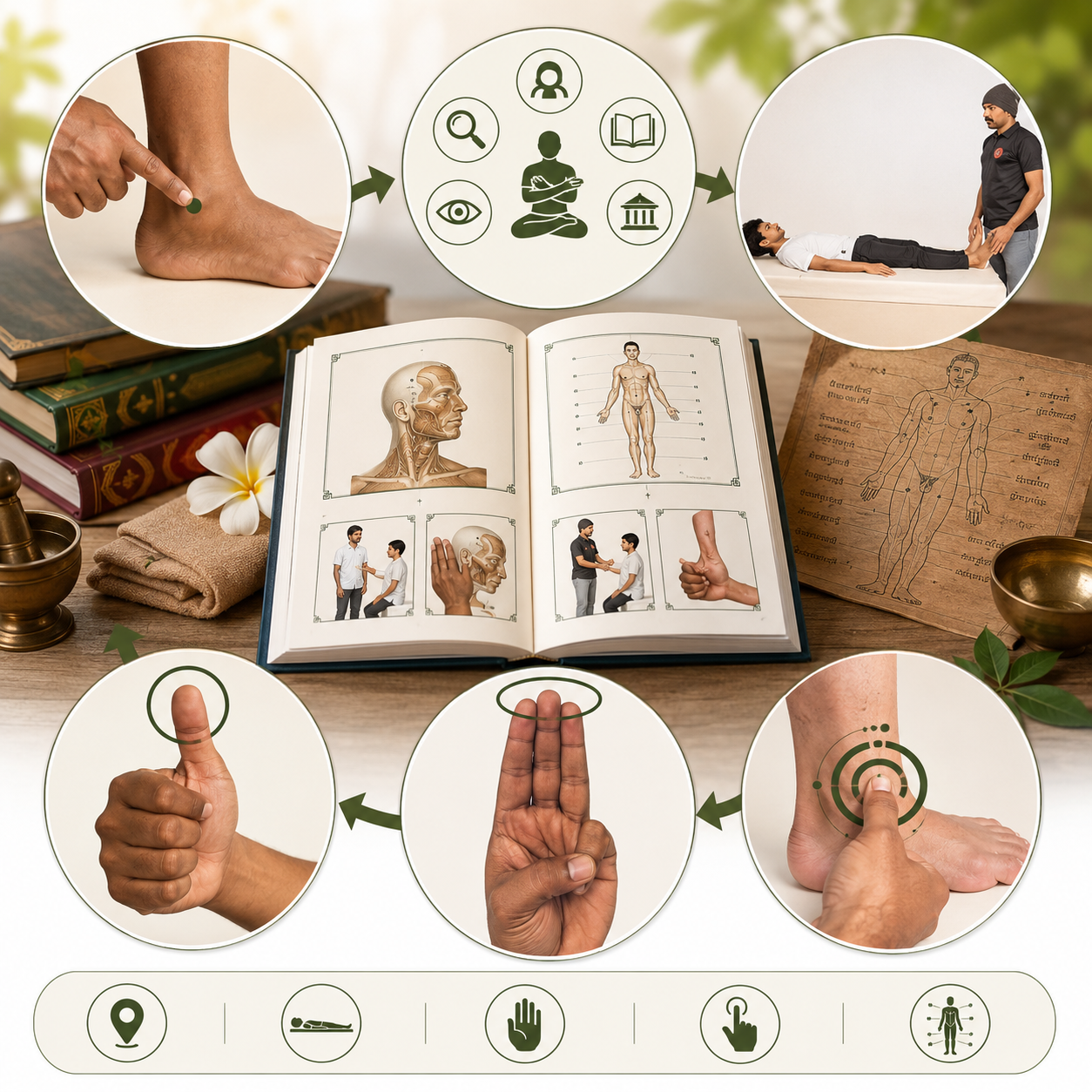
The Varmam Combo — Volumes 1 & 2
159+ Varmam locations and 48 Adangal methods — Adangal being the release techniques of the Siddha tradition — written out in plain language with the classical sources named. The reference book behind everything on this blog.
The Sixty Seconds
Do this sitting on the edge of the bed, before your feet take any weight.
- Three slow breaths. Not deep ones — slow ones. Let the out-breath take longer than the in-breath. Do nothing else during these three breaths.
- Wrists. Ten slow circles each way. Small circles. You are not stretching; you are reminding.
- Ankles. Ten slow circles each way, one foot at a time. Same principle.
- Fingers and toes. Open the hands wide, close them. Five times. Spread the toes, curl them. Five times.
- One more slow breath. Then stand.
That is all of it. Wrists, ankles, fingers, toes, breath.
Every one of those locations sits in the busiest part of both maps. Ayurveda names Manibandha at the wrist, Gulpha at the ankle and Talahridaya at the centre of the palm and the sole. Siddha names Manipantha Varmam at the wrist and Vellai Varmam at the base of the palm. Two traditions, two vocabularies, the same handful of square centimetres.
Notice what is not in this practice. No force. No pushing into pain. No holding a stretch for thirty seconds while your face does something unpleasant. If anything is sharp or tender, stop — that is the tradition’s own instruction, not a modern disclaimer added on top of it.
Give It A Week Before You Judge It
One morning will tell you very little. Seven mornings will tell you a lot — because what you are looking for is not a dramatic difference.
You are looking for a shorter gap. Many students report the stiffness easing sooner than it used to, and noticing it only in retrospect, on a morning when they stand up and realise they did not have to wait. Some notice nothing at all, and that is worth knowing before you start.
Either way, the real work is happening somewhere else. Your body has been sending you the same report at the same time every morning for years, and until today it had not occurred to you that it was a report at all.
When this post is not about your situation
Morning stiffness that is severe, that lasts well past an hour, that comes with swelling, heat or redness in a joint, or that arrived suddenly after a fall — that is a conversation for your doctor, and it should happen soon. Traditional practices sit alongside proper medical care. They never sit in front of it.
Saram First Reset™ — Your First Five Days Of Practice
Reading about a practice is one thing. Being walked through it, in order, on video, is another. Five short days: your first Saram lesson, breath observation, practices for breathing ease and digestive comfort, and family care. No flexibility, equipment or floor space needed.
Final Thoughts
Two traditions, working two thousand years apart from each other in two different languages, both decided that the places worth marking on the human body are the places where things meet. Then both of them spent centuries insisting that those places be approached gently.
Your morning stiffness turns up at those exact locations, every day, on schedule. You do not need 107 points or 108 points to work with that. You need one minute, five joints, and the habit of paying attention.
Start tomorrow. Before your feet touch the floor.
Learn it properly, in five days
The Saram First Reset™ takes you through the foundations in sixteen short videos over five days, self-paced, for ₹499. Finish it and you are a Saram First Reset™ Graduate — the first step on the path.
Prefer to start free? Our Inner Circle community call runs every Thursday, 7.30–9.30 PM. Write to connect@vedhansri.com.
5,500+ students trained · 28+ years of practice · 27+ master teachers learned from · 3 national recognitions