
What Is Varmam? The Siddha Science Of Pressure Points, Explained Simply
Your grandmother pressed the sides of your forehead when your head hurt. Nobody taught her the name for it. This is the name for it.
There is a therapy in India that most people have already used without knowing it.
You roll your palm clockwise on your stomach after a heavy meal. You press the sides of your nose when it feels blocked. You rub the base of your skull after a long day at a screen. Nobody sat you down and taught you those. Your hand simply knew.
That instinct has a name, a map, and 5,000 years of documentation behind it. It is called Varmam — pressure points on the body — and it is the oldest layer of the Siddha tradition of South India, carried today inside the practice we teach as Saram.
This post will give you the whole picture in plain words: the four pillars Varmam stands on, why the number 108 keeps appearing, what an adangal is and why it matters more than most people realise, and eight named points with their locations that you can find on your own body before you finish reading.
Why Varmam Deserves Your Attention Now
Siddha is one of the oldest and most complete of the Indian traditions of wellbeing, and Varmam is the part of it that works with the hands rather than with medicine. Nothing is swallowed and nothing is invasive — the whole system is built on where you place your hands, how much pressure you use, and when.
What makes Varmam unusual is that it is not only a set of techniques. It carries its own branches of medicine and oil preparation inside it. That is rare. Most external therapies borrow their pharmacy from somewhere else. Varmam stands as a complete healing science in its own right.
What should be done about it? Learn the map before you learn the moves. Most people meet Varmam through a single technique someone showed them, apply it to the wrong situation, and conclude the system does not work. The map is what makes the technique reliable.
How do you start? By understanding the four pillars below. Every practice, every point, every caution sits inside one of them.
What happens if you do — and if you don't? People who learn the structure first find that the individual techniques become obvious afterwards. People who skip it collect a folder of disconnected tips and never build judgement. Varmam is a self-learned therapy in the sense that the knowledge is already embedded in you — but only structure lets you reach it deliberately instead of by accident.
The Four Pillars of Varmam
1. Life Science — how you live from dawn to dusk
This pillar looks at your day, not at your symptoms. Early morning routines. What you wear. How you sit. Your occupation. The rituals you keep without thinking about them. All of it either supports the flow of life energy or interferes with it.
It is a genuinely different way of looking at health: not as treatment applied after something breaks, but as the accumulated result of a thousand small daily choices.
2. Self-Defence — protecting and recovering
Varmam sits inside the martial traditions of the region — adimurai, silambam, kalari payattu — and it travelled outward from there into forms practised across Asia. It teaches both halves of a fight: how to block, and how to bring someone back afterwards.
On the old battlefield, a wounded warrior had two possible fates. Either he was carried home for treatment, or, if capture was certain and the kingdom's secrets were at stake, a Varmam point was used to release him rather than let him be tortured. The same knowledge served both ends. That is precisely why the tradition guarded who it taught.
3. Wellbeing — Varma Maruthuvam
This is the branch most people mean when they say Varmam. Varma Maruthuvam is a documented branch of the Siddha tradition, preserved in manuscripts written in ancient Tamil over many centuries.
Those manuscripts describe 108 locations where body, mind and soul meet along the path travelled by life energy — and much more besides: methods of diagnosis, relieving injuries through ilakkumurai, preventive work through thadavalmurai, setting fractures, pain management, medicine preparation, alchemy.
Three broad ways this pillar works with the body:
- Supporting recovery after an ailment or injury
- Rejuvenating body, mind and spirit together
- Working at the level of the cell to support overall quality of life
4. Spirituality — the pillar people skip
Varmam also carries rejuvenation practices aimed at kayakalpa — a state in which every system in the body performs its original function at full efficiency. It is not a promise of immortality. It is a description of a body that is not leaking energy.
The tradition holds that this pillar helps a person find the purpose of their life, and meet its end without struggle. Whether or not that interests you, it explains why the old teachers refused to separate the technique from the discipline.
Why 108? Paduvarmam, Thoduvarmam And The Arithmetic Of The Body
The number 108 appears everywhere in this tradition, and it is not decorative. It comes out of an arithmetic that is worth understanding, because it changes how you treat.
The 108 locations divide into two groups by the effect they produce:
- Paduvarmam — 12 points. The major locations. An injury at one of these is serious; the classical texts are blunt that damage here can lead to lasting disability or worse.
- Thoduvarmam — 96 points. The connected locations. Each Paduvarmam links to eight of them.
Twelve major points, each carrying eight connected points: 12 + (12 × 8) = 108. And here is the practical consequence — activating one Paduvarmam activates all eight of its Thoduvarmam at the same time. One well-chosen point does the work of nine.
This also explains something that confuses beginners. The place that hurts is often not the place to work. An injury at a single point disturbs the balance at every other point along its pathway. Treat the site of the pain alone and you treat a symptom of a disturbance that started elsewhere.
The same 108, counted a dozen different ways
Here is something that surprises people. The 108 locations can be classified through almost any lens the tradition uses — the three humours (tridosha), the five elements (panchabhootas), the six chakras, the five zones of the body, even the zodiac signs. Approach from any direction and you arrive at 108.
That consistency is the clearest sign that this was a mapped system, not a collection of folk remedies.
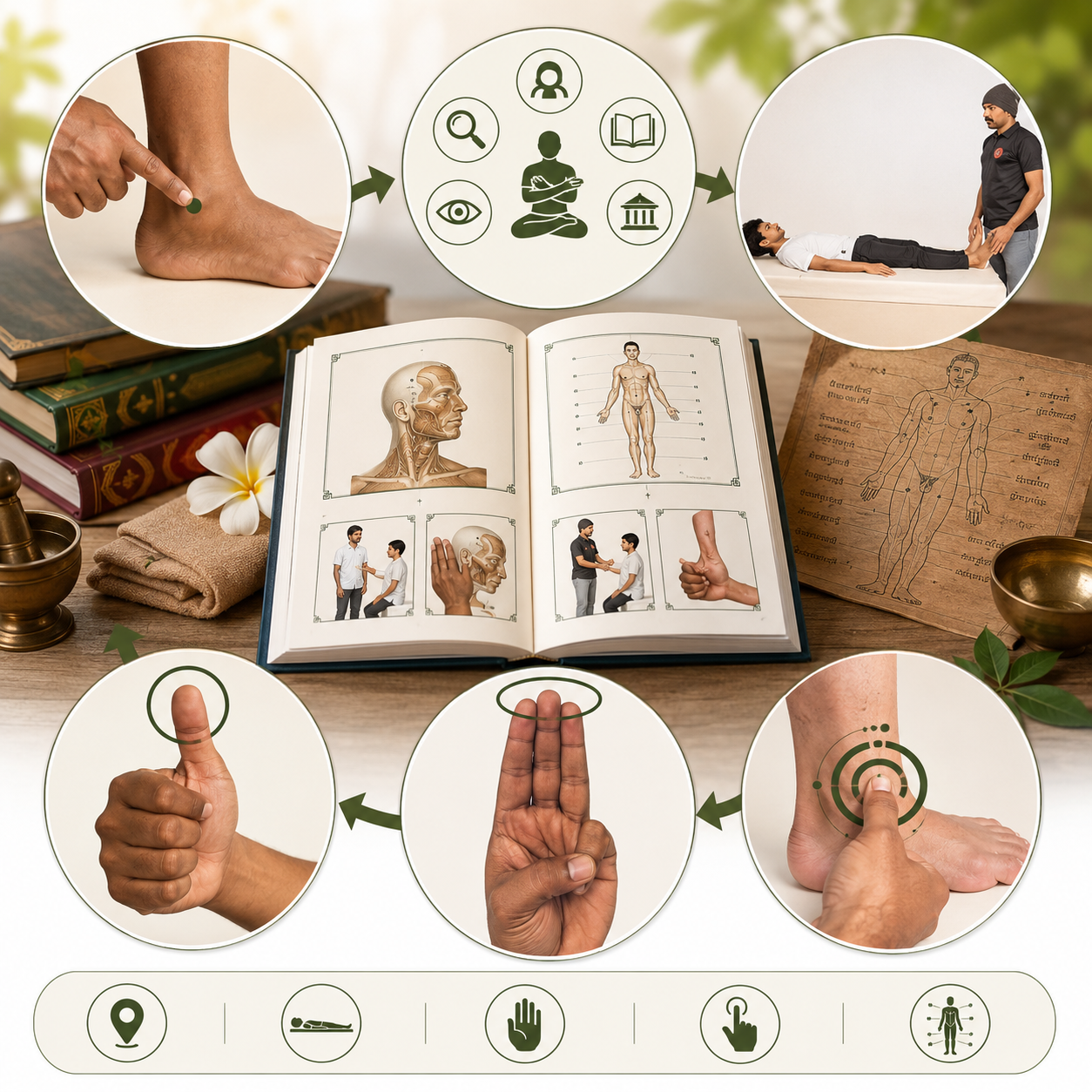
Varmam Volume 1 + Volume 2 — The Combo
159+ Varmam points and 48 Adangal methods, across both volumes. The first English books on Varmam, built from the original manuscripts — if the 108 locations and the reservoirs interested you, this is where they are set out point by point.
Combo offer — ₹3,619 for both volumes
View the combo offerAdangal: The Reservoir Most People Have Never Heard Of
If you remember one idea from this post, make it this one.
Varmam points are where flow can be disturbed. Adangals are where energy is stored. They are reservoirs, sitting close to the points that may need them, and they behave like capacitors in a circuit — holding a charge in reserve, ready to release it.
When a person is injured or unwell, the flow of life energy is disrupted, and the imbalance shows up in the body as a health disorder. The energy held in the adangals is what a practitioner draws on in the relieving procedures, to correct that imbalance and support recovery.
The tradition counts 12 peradangals — the major reservoirs — and 56 sitradangals, the smaller ones.
What happens if you know this, and if you don't? A practitioner who only knows points spends the session pushing on a system that has nothing left to give. A practitioner who knows the reservoirs opens the supply first, then directs it. It is the difference between pressing harder and pressing correctly.
You Have Been Activating Varmam All Your Life
Activating a Varmam point is far simpler than most people assume. It does not require force. It rarely requires strength at all. The way you dress, sit, stand and carry yourself is already doing it. A light touch — a feather touch, a mother's touch — is often enough.
Once you see this, the culture around you starts to look different.
Attire
The turban. Tying a turban stimulates the Varmam locations around the head, and the tradition connects this with focused, concentrated, impartial thinking. Village heads across India, and communities from Punjab to Rajasthan, have worn one for centuries.
The thread at the waist. People once tied a black or red thread around the waist as a matter of course. It crosses the longest Varmam in the body — Sadayantha Varmam, which runs the full circumference of the waist — and it was understood to support digestive comfort and hold the organs in place.
Accessories
Jewellery is Varmam stimulation too. Classical dancers wearing their full ornaments are supported in focus, posture and steadiness. The bangles given to a pregnant woman at a traditional baby shower were never only ornamental; the practice has a protective intention behind it, one that our grandmothers understood without needing the anatomy.
Manifest don’t need your time and speed.
Eight Points You Can Find On Yourself Today
These are simple tapping techniques that anyone can apply, on themselves or on someone else. Tap gently. Nothing here needs force, and if anything is tender or painful, stop.
| Point | Where it is | What it is traditionally used for |
|---|---|---|
| Kaakattai Varmam | Four finger-breadths sideways from where the neck meets the shoulder | Many people find it eases neck and shoulder tightness, and report feeling steadier afterwards |
| Ner Varmam | Centre of the chest | Tapping here is used to support easier, fuller breathing |
| Agadwaram | Centre of the spine | Used to encourage energy movement through the body |
| Pakshi Varmam | Centre of the thigh | Associated with strength in the legs and with building courage |
| Ullangai Adangal | Centre of the palm | Energising the hands — the starting point for anyone learning to give touch |
| Ullangaal Vellai Adangal | Centre of the sole of the foot | Used to support energy movement through the whole body |
| Thivalai Varmam | Four finger-breadths below the collar bone | Traditionally worked with for ease of breath and for bladder comfort |
| Nema Varmam | Centre of the forehead | Used to settle and relax the mind |
How to try one. Start with Nema Varmam, the centre of the forehead. Sit down. Tap lightly with the pad of the middle finger, at about the speed of a slow heartbeat, for thirty seconds. Then stop and sit still for another thirty. Notice what changed and what didn't. That noticing is the actual skill — the tapping is the easy part.
16 videos
Saram First Reset™ — Your First Five Days Of Practice
Reading about the points is one thing. Having someone walk you through them, in order, on video, is another. Five short days: your first Saram lesson, breath observation, practices for breathing ease and digestive comfort, and family care. No flexibility, equipment or floor space needed.
Start the 5-day reset — ₹499Who Varmam Is Actually For
Varmam is simple enough for anyone to learn as self-care, and it sits alongside whatever else you already do rather than replacing it. Most people meet it as a daily practice for their own comfort, not as something done to them by somebody else.
But the audience is wider than clinics. This knowledge is worth having if you are:
- Looking after your own health, and would rather notice a signal early than treat something late
- A caregiver for a parent or a child, wanting something gentle you can offer with your hands
- A yoga teacher, coach or therapist wanting a tradition behind the technique you already use
- Considering a path in holistic healthcare and looking for where to begin
Many students describe a shift in how they read their own body — the stiffness noticed on the third step out of bed, rather than after six months. That awareness is what the practice builds first.
Final Thoughts
Varmam is old, it is documented, and it is still here — which is more than can be said for most of what was practised 5,000 years ago. It survived because it works with something every living body already does, and because generations of teachers refused to hand it on carelessly.
You do not need to master 108 locations to benefit from it. You need the map, one or two points, and the habit of paying attention. Start with the forehead. Start this evening.
Learn it properly, in five days
The Saram First Reset™ takes you through the foundations in sixteen short videos over five days, self-paced, for ₹499. Finish it and you are a Saram First Reset™ Graduate — the first step on the path.
Adapted by the author from “Varmam: A Modality of AYUSH for Holistic Wellbeing”, first published in Heritage Amruth, Vol 20 Issue 2, March–April 2024. Sri Ramesh Babu (Vedhan Sri) is Founder Trustee of Varma Kalpa Rejuvenation Center.